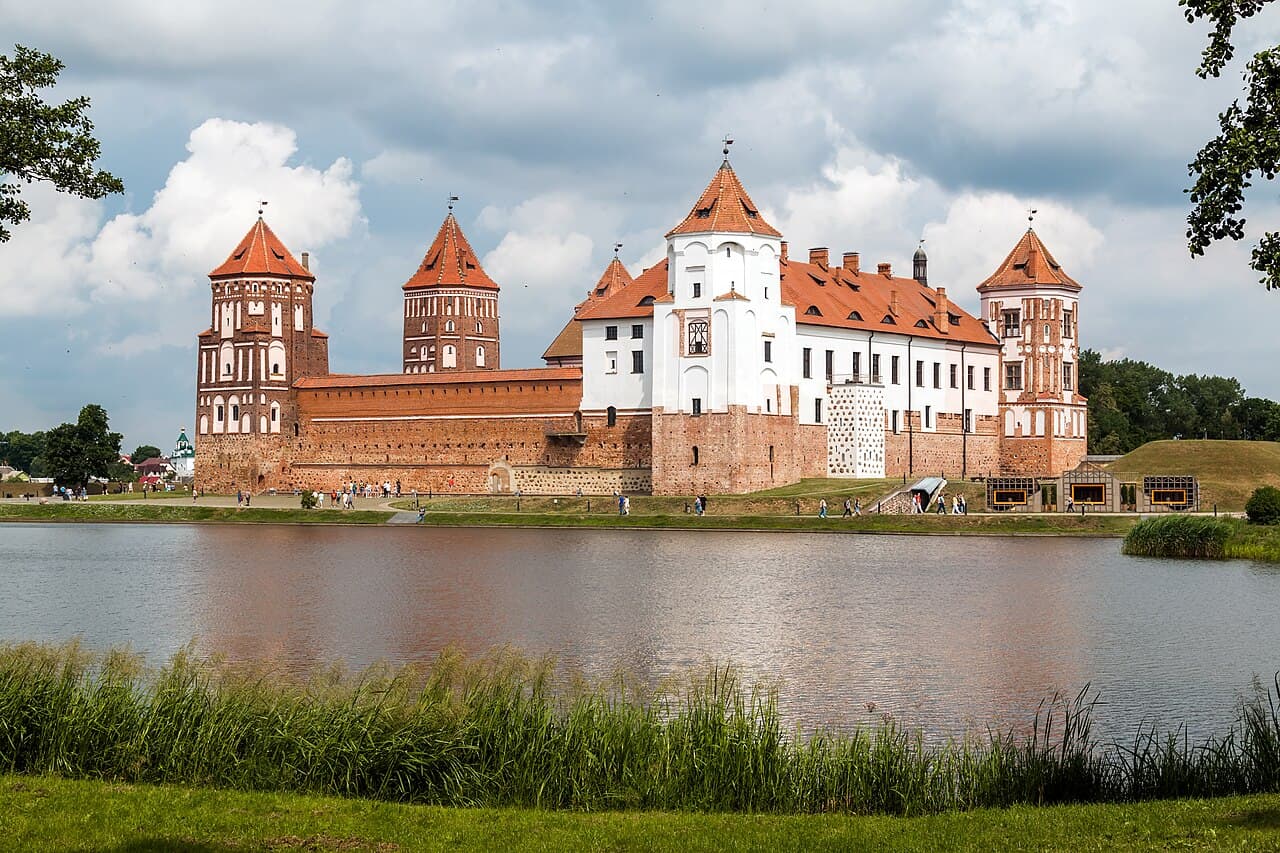
“One of the meanings of the word ‘wanderer’ is a traveller, a seeker of treasures. And I keep a little key hanging on my car’s dashboard — it is with this key that I unlock Belarus.”
How the idea came about of getting to know his country better, driving through every corner of it and telling others about it — an interview with the traveller, author of the “200 unique travel routes of my Belarus” project and founder of the website Valatsuga.by, Uladzimir Tsvirko.
How it all began
— Indeed, I have loved travelling since childhood. I always enjoyed making my way into places no one else would reach. Later, of course, I would show off to friends and family, telling them what I had learned and seen. I tried to keep travelling, even during the difficult years when my children were growing up and there was very little time for my passion. Sometimes I even went without a camera — I would simply look, memorise, and draw strength and energy from the incredibly beautiful places of my native land.
I can name the starting points, the moments that pushed me towards developing routes. Often, friends and neighbours would gather at my dacha in Khadakava to look through the pictures from my journeys. The show was put on with a projector and a large screen. The photographs were accompanied by commentary: brief historical notes as well as personal impressions of what had been seen. The guests were amazed: could such beauty really exist here, in Belarus?
Later, colleagues from Canada and the USA came to visit one of my friends, an architect. He took the foreigners along a tried-and-tested route — Mir to Nesvizh. And on the way back he dropped by to see me in Khadakava. I asked them: “So, what are your impressions?”. I was very surprised to realise that they knew more about our castles than we did. But I did not notice that anything had truly touched or moved them. So I started telling them about the churches, the Catholic and Orthodox churches, the ruins that could be seen along the way. And what do you think? The very next day they went to see them... My friend told me later: they all but wept as they touched the ruins with their hands. They said: this is what history is.
That is exactly how the idea was born — to unlock Belarus for ourselves and to show it to others.
The “200 unique travel routes across my Belarus” project
— Of course, I am not a pioneer in this field. Plenty has been published and printed on travel topics, and a lot of information can be found on the internet. But in most cases it is all encyclopaedic facts. For a traveller they are practically useless. What I wanted was to make things simpler for those who want to learn more about Belarus.
All of my routes are divided by region, with exact coordinates given. Initially, 150 “golden routes” were planned. But as I travelled and photographed the sites, I realised there would be far more of them. The project is now called “200 unique travel routes across my Belarus”. And that is not the limit. At least 50 more are in development. At the moment, 176 routes are fully ready for travel, along with thematic ones — about springs, crosses, the pyramids of Belarus, and more.
There is the “Castles of Belarus” route: starting at Kreva, Halshany and Geraniony, passing through Navahrudak, Lida and Lyubcha, and finishing at Mir and Nesvizh. In some places only a wall remains, but there are bastions and moats. You look at them and feel shivers down your spine. Such beauty truly once existed.
Among the thematic routes, I like the “Holy Lakes” route in the Vitsebsk region. It includes 8 lakes, the village of Rai and the Svecha river. The Holy Lakes are all different: tiny and large, fairy-tale and secluded, extraordinary…
And the uniqueness of the project lies in the fact that the traveller always has a choice — where to go, how, by what means, and for how many days. Here I should mention the difference between a tourist and a traveller. A tourist boards a bus and is shown and told what the programme prescribes. They have no choice, while a traveller does. A traveller is a free person.
Out of 200 routes, a person can pick the ones that interest them most, based on geography, personal or professional preferences. They can go and see a single route, or combine two or three in one journey.
Each route has 8–10 points. It is worth understanding that these points lie at some distance from one another. And there are places like the village of Smaliany, for example. There you will find the ruins of a castle, a Catholic church, an Orthodox church, a burial chapel, the tomb of Tomas Zan, a former manor complex and stone crosses. Smaliany is a separate route — because a single village holds 10 points.
In total I have compiled 53 routes for the Hrodna region, 36 for Minsk region, 33 for Brest region, 30 for Vitsebsk region, 15 for Mahiliou region and 9 for Homel region. This obvious disparity in numbers is connected not only with the Chernobyl disaster but also with historical upheavals. Still, the Mahiliou and Homel regions genuinely do not have that many architectural monuments.
Other projects
— Yes, in time, standalone projects began to emerge from the one big project, “200 unique travel routes across my Belarus”: “Our Ruins”, “Endlessly Charming...” and “Silhouettes of Heritage”. All of them are published in newspapers and magazines. The routes appear in the newspaper “7 Dzien”, materials from the “Our Ruins” project in the magazines “Biarozka” and “Maladosts”, “Silhouettes of Heritage” in “LiM”. And since this year, articles from the “Endlessly Charming...” project have been published in the newspaper “SB. Belarus Today”.
While driving through the villages and small towns of Belarus, I once felt a strong desire to photograph the provinces. That is how the “Endlessly Charming...” project appeared. Villages are disappearing, changing beyond recognition. And what is a village in the traditional sense? Little shops, small windows, roofs, wells, headscarves... And this is something we can still manage to capture and preserve in memory.
The “Our Ruins” project is not a reproach but a statement of fact. One should never be ashamed of ruins — one should know they exist and be sure to preserve them. It is encouraging that today the ministry of architecture is talking about conservation. I spoke about this back at the start of my project in 2010. And conservation is preservation. My opinion is that everything must be conserved, every single stone must be cared for — because, according to statistics, only 3 percent of the architecture we once had is left.
By the way, three projects — “Our Ruins”, “Endlessly Charming...” and “A Random Shot” — can also be found on Facebook.
Another project, “The Texture of Time”, is still taking shape. We will tell you about it later.
How the idea of the website was born
— I very much wanted all the information I had gathered to be made available to people. There is no better option than a website. It is convenient for the traveller, and it makes it possible to hold a large volume of information in one place.
One of the website’s features is a function that lets you look at routes located near the one you have chosen. Suppose someone set off on a route for just one day but decided to stay longer and see something else as well.
Today many people — architects, historians, literary scholars — organise their own routes and run excursions along them. All of them have a right to exist. And so does the website valatsuga.by. A person visits the site, chooses what interests them, gets in the car and sets off on their journey.
By the way, one of the meanings of the word “valatsuga” (wanderer) is a traveller, a seeker of treasures. And I still keep a little key hanging on my car’s dashboard — it is with this key that I unlock the architectural and other treasures of Belarus to this day.
About legends
— Oral tradition is no lesser a treasure than the castles and ruins themselves. The stories and legends connected with cultural, architectural and natural landmarks need to be preserved for posterity. After all, they too pass away with the person, with their life.
And what is architecture? It is people. Those who built a particular church, castle or palace, who used it, destroyed it, restore it. And where does a building stand? Among people. And people know a great deal about it. Believe me, what matters to a traveller is not so much the encyclopaedic facts (the year of construction, the style, the architect’s name) as the stories connected with these places.
Whether to believe the legends or not is everyone’s own business. But there is no getting by without them: I have more than 150 of them...
The future of the project
— First and foremost, we want the project to work fully on the internet. That requires publishing all the information that has already been prepared. But the website will not be mothballed — information will keep being added and updated.
Is a printed edition on this subject conceivable? Yes! The plans include both a gift edition and a handy reference book for travellers. These, too, will feature photographs of the sites, legends and brief information.
My dream is to open a travel bureau and take people to the places that have already been seen and photographed once. To return again and again to the places I once drove through and walked — places which, like precious gemstones, most likely still hide unseen facets...