
One can't help but admire people like Vladimir Tsvirko. After all, he is one of those hardy, talented Belarusians who can both create ideas and bring them to life.
He is an artist, an ethnographer, a traveler, a local historian, a philanthropist, a builder, and a jack of all trades.
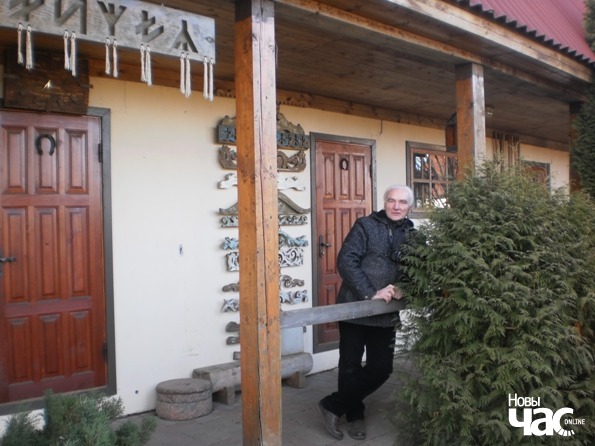
I found out about this unusual man via the Internet, called him, and Vladimir Andreevich cordially invited me to his cottage, which is located in the village of Khodakova, near Minsk. Vladimir Tsvirko's 2-storey building and estate are visible from afar: all his neighbors have high fences around their cottages, and he has only beautiful wooden carved gates, as if asking, "please come in!"
From his dacha, dear Vladimir Tsvirko has created a very interesting, informative ethnographic museum, a real wonderful treasure trove, which includes over 2 thousand exhibits, from the smallest Komsomol icon to the largest and most interesting exhibit, perhaps the only one in Belarus operating a windmill with a height of only 3 meters.
Vladimir Tsvirko began to introduce me to his unusual museum from the smallest mill in Belarus. And he moved it from near Drogichin, where the mill had been operating since 1936, but over time only the internal mechanisms remained of it, and the wooden paneling rotted away. Vladimir moved the Khodakov mill, restored all the wooden parts, and made wings. And now many visitors come to his ethnographic museum-cottage both from Minsk and from other localities to admire this miracle of the minim mountains, as well as other exhibits of the museum. And Tsvirko, sparing no time, welcomes all of them, along with his affectionate dog named America, without charging a penny for a visit.
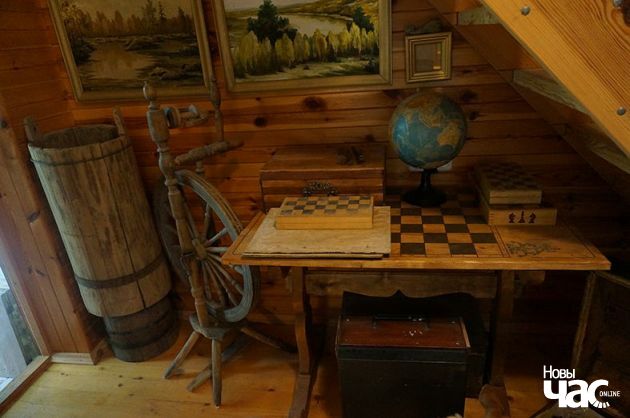
The history in the Vladimir Tsvirko Ethnographic Museum is viewed at every step. The collection of polished samovars and clay jugs smoothly turns into a collection of rare books and magazines. There are also samples of clay tiles, which were exported from Belarus to Western countries in ancient times. There is also a collection of heating irons, spinning wheels, musical instruments, and embroidered items, some of which are about a hundred years old.
And Vladimir Tsvirko started his museum with three things that were left to him from his mother: a spinning wheel, an iron and a bread shovel. Over time, many things were given to him by his friends and acquaintances. My gift is 40 volumes of the 1954-1955 edition of the Great Soviet Encyclopedia, which were also added to the Vladimir Tsvirko Museum.
On the territory of the estate, Vladimir dug a pond with crucian carp, and made a hut with a Baba Yaga. Almost everything in the building of the cottage museum, starting from the wooden stairs to the second floor and ending with the fireplace, was made by the deft hands of Vladimir himself.
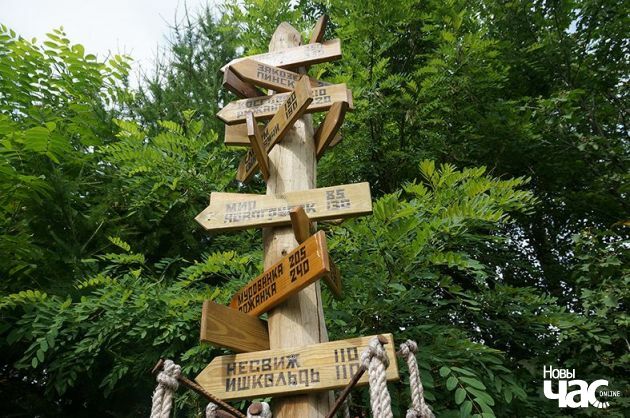
Vl. Tsvirko road sign
Even a road sign attracts attention, where arrows indicate the distance in kilometers from his museum to many settlements in Belarus. And Vladimir traveled around Belarus and walked around the length and breadth in search of unexplored buildings that were once landmarks, of which today only ruins remain.
Vladimir Tsvirko is a traveler, the author of the unusual project "150 golden routes of my Belarus". He said that during his trips he had seen many abandoned historical buildings that were not in operation and were not maintained in proper condition. Once there were signs on them that they were preserved by the state, and the buildings were considered historical value, after they were removed the signs, and gradually these interesting objects come to a depressed state, demolished, become ownerless. Therefore, the idea was born in Tsvirko to travel all over Belarus, photograph these objects, write about them, so that as many people as possible would learn about the historical past of our country. Vladimir also hopes that the country's leadership will pay attention to these monuments of the past.
Before starting his project, Vladimir Tsvirko studied a lot of historical literature, worked in archives, and compiled routes for his travels, of which he had 150, including 28 routes in the Brest region, 24 in Vitebsk, 8 in Gomel, 36 in Grodno, 14 in Mogilev, and The Minsk region has 28 routes.
In the summer of 2015, Vladimir Tsvirko's first reference book from the series "150 Golden Routes of my Belarus", which has no analogues, was published in the Minsk publishing house "Turinfo". The 40 pages of the lavishly decorated photo edition present the reader with 36 corners of Minsk region rich in historical events. Here you can find information about Yakhimayshynu, where Yanka Kupala prepared his first collection of poems "Pipe", and about interesting ancient buildings of Rakov, Iventsa, Vishnevo, Loska, Dzerainai, Rubezhevichi and other places.
By the way, it is planned to issue more than 30 more of the same guides, which will tell about other 114 routes in Belarus. It will be a great gift to local historians, students and everyone who is not indifferent to the history of Belarus. It should be emphasized that Tsvirka's project "150 golden routes of my Belarus" is the winner of the XI National competition "Golden Literature" for 2015 in the nomination "The best materials on cultural and historical subjects".
Belarusians have a good proverb: what is a seed, such is a tribe. Judging by her, the environment in which Vladimir Tsvirko grew up was very favorable. He was born in 1957 in the urban settlement of G181. His father, Andrei Grigorievich, went through the entire war, fought his way to Berlin, and received 5 severe wounds. For his courage and heroism, he was awarded the Order of the Red Star and numerous medals, and after the war he worked as a builder. His ancestors were originally from Volhynia.
His mother, Vera Dzyam'yanaina (maiden name — Vysotskaya), came from an ancient noble family of the coat of arms "Dryya", worked as a teacher at a school. She was very educated, knew 4 languages (Polish, Hebrew, Tatar and German), and drew well. During the German occupation, she hid two Jewish children in her house under threat of death: a boy and a girl. She tarred their cropped heads and told everyone that they were her sick children. For their sake, Vera Jiam'yana also kept a cow. After the war, the girl was taken away by her relatives, and she no longer knew anything about her fate. And the boy, Stanislav, eventually became the director of the Volgograd Tractor Plant, and more than once visited his savior and her family.
All the best qualities from his parents went to Vladimir, who, having good artistic abilities, studied for 5 years at the art school of A.S. Vakhromeev, graduating in 1983, received a diploma in the specialty of artist-designer and draftsman-designer. Vladimir worked at one of the design institutes in Minsk and taught at an art gymnasium. He also directed the studio "Three Colors". And in 1999, he created a creative studio for the production of Tiffany stained glass windows. Vladimir Andreevich has repeatedly participated in exhibitions of graphics and art photography. Many of his works of art are located in Germany and Austria. In Canada and in private collections.
Tsvirko is also known as a patron of the arts: he charitably installed art stained glass windows in the Holy Trinity Church of Peace and in the village of Berezhno in the Korelichi district. Vladimir is also a philatelist. There are over 18 thousand stamps in his collection. Now Vladimir Andreevich runs a creative studio for the creation of stained glass windows, restoring ethnographic exhibits and antiques. He claims that he feels like a happy person. His reliable life partner, his wife Anna Nikolaevna, works as the CEO of a small construction company, and also grows vegetables in the country.
The Tsvirko family has two daughters, Ekaterina and Tatiana, and a son, Evgeny. There are also two granddaughters and a grandson. Our contemporary Vladimir Andreevich is so ordinary, but somewhere extraordinary.
Tsvirko lives next to us and brings benefit and joy to people.