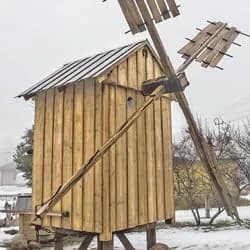
< p style="text-align:justify;">we are considering an engineering miracle and simultaneously listening to an introductory lecture on the history of mill construction. It turns out that the windmills, which were built on the territory of modern Belarus, belonged to two different types by design — tents and trestles. The collective image of a windmill goes back, rather, to the first one-this is the most impressive structure, in which only the upper part with wings turns to the wind. In the gantry, the entire body rotates on a special rotating platform to catch the airflow.
< p style= "text-align:justify;" > - There were quite a lot of such mills before the Great Patriotic War, but after the count went to units. And I had an idea to build a windmill on the site. I've already come to terms with the idea that I'll have to make a smaller version. And then I found out that, according to rumors, there is a real small mill somewhere near Drogichin. And indeed, with friends in the village of Mikitsk, we found this goat. Of course, it was in poor condition - after all, it had been standing in the open air for so many decades. Its owner even wondered: why do I need it? But in the end, I gave in when I found out that I wanted to restore the windmill. The restoration of the mill, I can tell you the exact time, took a year and 10 days. < p style="text-align: justify;">The old mill got a new lease of life-you can't tell otherwise by looking at the photos. In the picture, a half—rotted, blackened with age, askew on one side, leaning, apparently, on the first thing that came to the former owner's hand — a rusty canister, it stands in stark contrast to today's sparkling one. However, this novelty is deceptive-Vladimir Andreevich approached the project precisely as a thoughtful restoration, making the most of the old tree. For example, boards that have been lying idle for several decades were lucky enough to be found in a remote village. The replacement material was strictly the same grade of wood as in the original — a familiar forester helped to figure out the details. And now this windmill is fully worthy of being called a historical monument. < p style="text-align: justify;">Vladimir Tsvirko believes that he is already connecting with the past — with the end of the 40s of the XX century, when it was built, and with the family history of its creator. By the way, his photo is hanging inside as a tribute to his memory. And as a tribute to outstanding craftsmanship too. Vladimir Andreevich never ceases to be surprised by the golden hands of his predecessor. The degree of flour grinding, for example, is changed by light turns of the lamb nut: one small iron part controls the operation of heavy stone millstones and a two-hundred-kilogram gearbox rotating them! By the way, the new mill was somehow loaded with corn, and flour actually went out from under the millstones.Anton KOSTYUKEVICH.
< p style= "text-align:justify;" > < strong> Fact < / strong> < / p> < p style="text-align: justify;">Vladimir Tsvirko has developed about 150 routes around Belarus based on his trains that lead to various historical sites. The layout of the first guide brochure with a dozen interesting routes through the Grodno region is already ready. Each object is illustrated, provided with a small description and geographical coordinates that can be entered into the car navigator (by the way, Vladimir Tsvirko initially calculates his routes for trips by car, so all the sights are located along the way). In addition, there are legends-yes, an almost mystical story about the miller's son is attached to the guide to the Grodno region. Now Vladimir Andreevich is actively looking for sponsors to produce a brochure.
< p style= "text-align: justify;" > < strong > By the way < / strong > < / p > < p style="text-align:justify;">The history in Vladimir Tsvirko's domain can be seen literally at every step. In the house, the collection of clay jugs smoothly flows into a collection of rare books, which give way to filmstrips, and now the polished sides of samovars are visible, followed by samples of clay tiles, which were exported from Belarus to Western countries. And each subject has its own amazing story, Vladimir Andreevich is sure. With these words, he takes one of the many irons on the coals and suggests guessing whose profile is depicted on the flap. From the depths of time, a bearded old man like Santa Claus looks at us. But it turned out to be Leo Tolstoy himself! The fact is that after the writer was excommunicated from the church, the iron factories received an unspoken instruction to place the image of Lev Nikolaevich on the shutters. It was supposed to symbolize the eternal torments of the anathematized classic in hell.