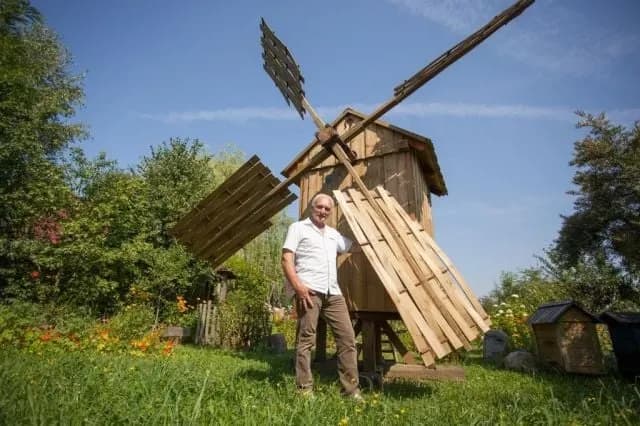
Two years ago, a Minsk resident moved a dilapidated windmill from the Drogichinsky district to his cottage near Minsk. A year later, he restored it. "AiF " went to see a working mill and a private…
Two years ago, a Minsk resident moved a dilapidated windmill from the Drogichinsky district to his cottage near Minsk. A year later, he restored it. AiF went to see a working mill and a private ethnographic museum in the village of Khodakovo, Minsk region.
< h3>Strategic object < / h3>
Vladimir Tsvirko brought the windmill from the Drogichinsky district: 85-year-old Praskovya Zhitkovich lives in the village of Mikitsk, whose father-in-law assembled this mill back in the 1930s. He went to Poland specifically to get the gearbox. The year of manufacture "1886" is stamped on it. Most likely, this mechanism was not created specifically for grinding, but only adapted by a skilled owner.
at one time, the mill was used not only by the Zhitkovich family, but also by fellow villagers. It is said that during the occupation, guards were even posted near the mill as a strategic facility. After the war, in 1955, the mill was restored. Until recently, the windmill was still used for its intended purpose. But after Praskovya Ivanovna's husband died, the mill stood idle in recent years. Dilapidated and out of service for a long time, it was not even suitable for firewood, the hostess is sure. The wings were lost, the turntable completely rotted, the roof-one name: "windmill". When the hostess heard that someone wanted to buy a windmill, she began to dissuade, saying that the firewood from it was bad, and the chimney would be full of soot from the old tree.
< h3 > all according to the originals < / h3>
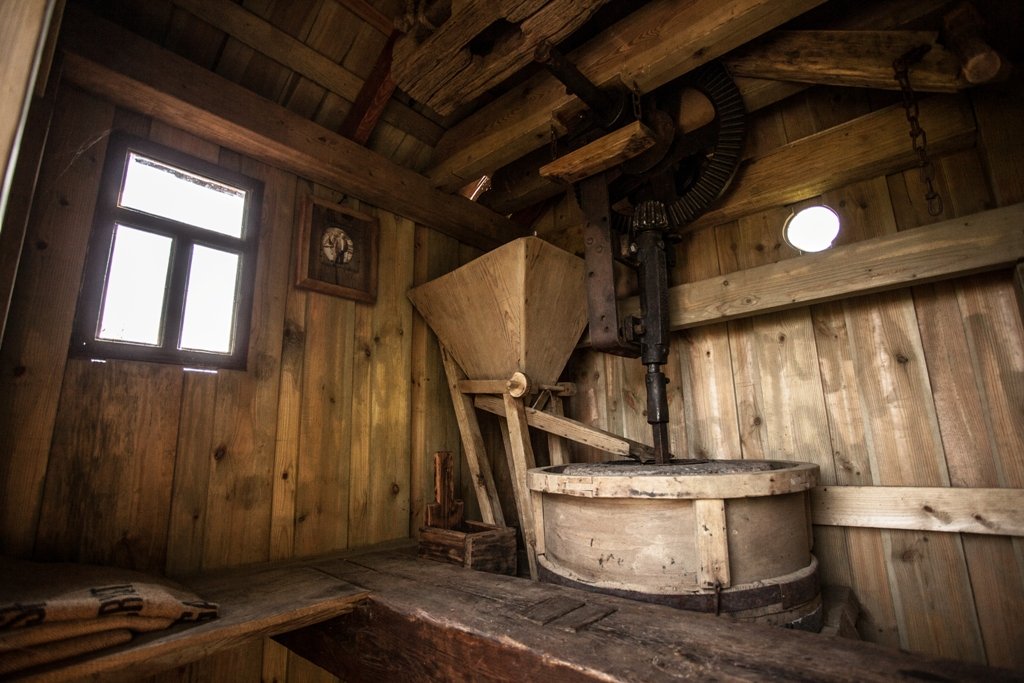
< p>Vladimir Tsvirko transported the mechanisms and main parts of the mill to his site: a gearbox, a millstone with a box where the Polish seal was preserved, a rotary platform with Balkans. The oil pan, where tar and grease were laid (according to the hostess, a piece of old fat was used) to lubricate the mechanisms and the rotary platform, was also preserved. Vladimir accurately restored the mill's premises and wings according to the originals. The only thing he allowed himself to change was to cut an additional window in the wall for more illumination inside the mill.
- It is so precisely made that, for example, by turning one "lamb" - a special nut - the gradation of flour grinding changes, - Vladimir is surprised at the skills of the old masters.
After a year and ten days of work on the mill, it was launched on July 20, 2013. Corn flour was immediately ground to check. Together with the gearbox, the rotation mechanism works on the mill: a drawbar fixed outside the mill can be turned towards the wind direction. The original brake for stopping the wings has also been restored.
< h3>New application < / h3>
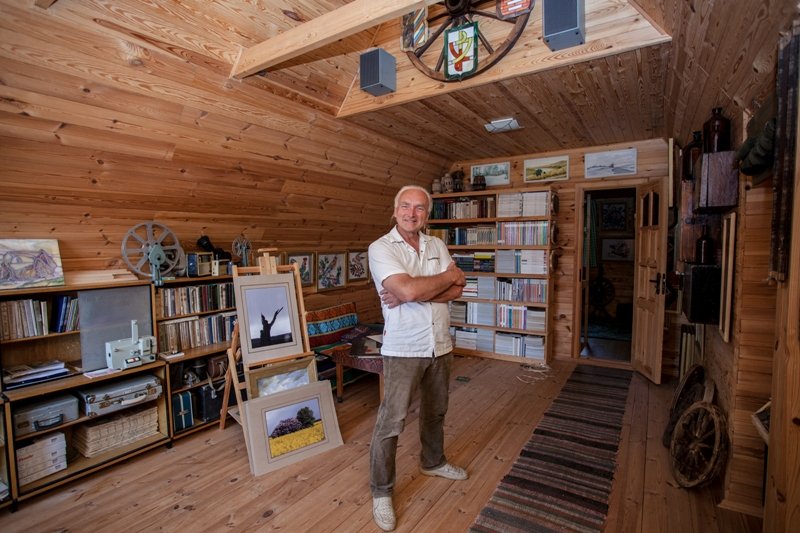
< P > Although the windmill is located in Vladimir Tsvirko's summer cottage, public access is open to it: friends and neighbors come to see the exhibit, and tourists often come. In addition to the windmill, there are two more houses with the rarest exhibits collected from all over Belarus.
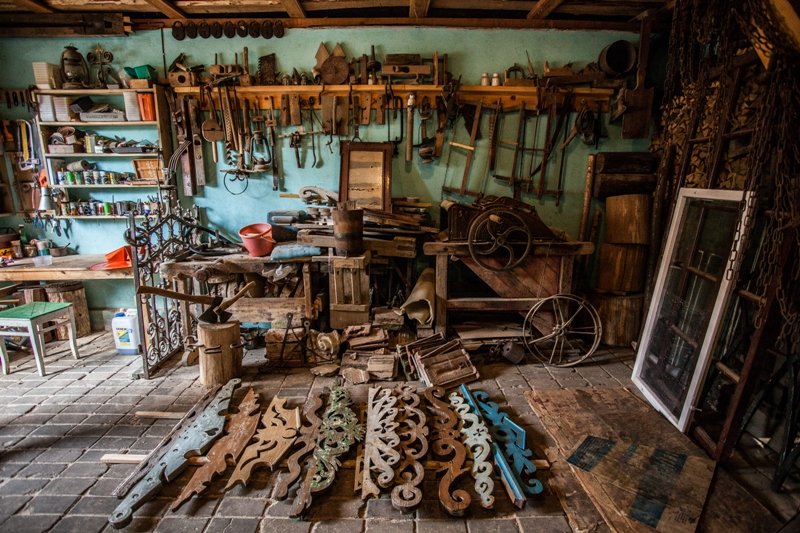
An avid traveler, Vladimir often brings unnecessary items from the trains to the owners, which he collects at the cottage. As a designer, he finds new uses for old things: the remains of an old armchair have become a frame, and twenty-four forged nails have become a panel. Collections of embroidery, watches, platbands-Vladimir collects various things. At the same time, each has its own story. Like, for example, the architrave that the dispossessed Vysotsky gentry family took from their name and decorated the windows of a new house built in the village with it. But at the request of the new authorities, the crowns had to be cut off from the lions carved on the architrave.
< h4 > the story of the landfill < / h4>
Many items in the Zwirko collection are of historical value. But the owners did not see this value and often simply threw away unique items. Double-glazed windows were installed in place of wooden frames from the 17th-century church during the "reconstruction". Someone made a greenhouse out of old frames. Vladimir literally took the arched frames from the landfill for himself.
Many of these things would have been gone long ago if they had been left in ruined houses and landfills. Not everyone sees value in them. Sometimes the owners of the given things come to visit me and tell me that they look different for me, that they are resurrected and continue to live on. Here they are transformed from old junk into works of art.
Vladimir says that he is chasing not so much old things as their stories. He shows a wooden bucket roughly hewn with an axe:
P.S. why didn't it end? Could something have happened to the master? It was as if time had stopped in this bucket. There is always some mystery in every subject.
< h4 > not a collector, but a collector< / h4>
Vladimir is constantly visited not only by friends, but also by people who have heard about the collection, which Vladimir calls a private collection.
- I don't really like the word "museum". It assumes standards and norms. And I don't even consider myself a collector, I'm a collector.
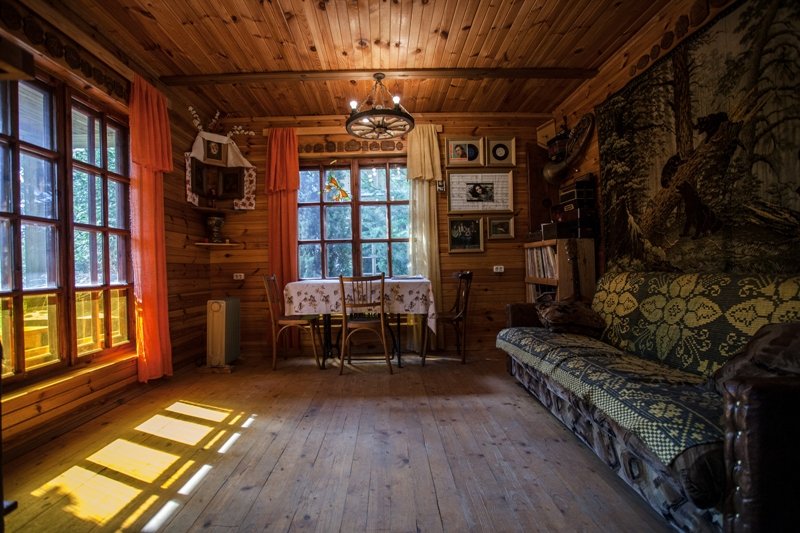
and in general, the main purpose of both houses is recreation. Columns for the Ukraine-7 movie projector are hidden under the ceiling near the old stained glass window, and you can watch, for example, the 1963 black-and-white film Paris from a Bird's Eye view.
- many things in my house do not burden me, because they live and even work. I'm not interested in purchasing an item and putting it on a shelf where it will gather dust. All things should continue to live with a person, to please him, to revive in memory pictures from his childhood, from the past of his parents, his ancestors.
< h4>The dossier < / h4>
< P > Born in 1957 in the urban settlement of Mir, Grodno region. He worked at the design institute, taught at the art gymnasium, and was the head of the Three Colors art studio. In 1999, he organized a creative studio for the production of Tiffany stained glass windows. He is engaged in the restoration of ethnographic exhibits, antiques and small architectural forms of landscape design. He charitably installed artistic stained glass windows in the Holy Trinity Church in the city of Mir. His works are in Germany, Austria, Canada and in private collections. Traveler and author of the project "150 golden routes of Belarus".
Legend < /h3 >
On the ceiling of one of the rooms there are two wooden wheels adapted for lamps. Even before the war, in the very heart of Nalibokskaya Pushcha, a master made them for a chaise. When he started work, he received an advance payment and assembled only the two front wheels. But the year 1937 came, and the customer was repressed. However, the master refused to resell the wheels to anyone: "and if the person returns? I got an advance payment," he replied. The colossus spent his whole life in the attic. The master is dead. The wheels were taken by my sister, who also did not give them to anyone - she also lived with the hope that at least the client's relatives would show up. Vladimir found these wheels from a forester, the brother of the master's sister.
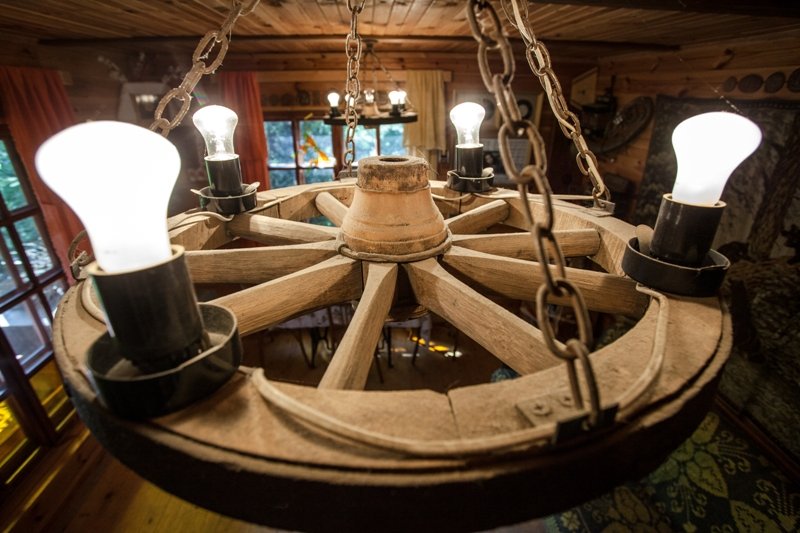
- We talked for more than two hours, and when I was leaving, the forester stopped me at the gate: "what if the man does come back?"That's how faith, decency, and professional duty were felt in those words! I explained to him that I was going to make lamps out of the wheels. And then he quietly said to me, "Maybe he will come back to the world after all?"
< h4>
to the topic < /h4 >
Windmills appeared in Northern and Western Europe in the 12th century: in Flanders, Southeastern England and Normandy. At the end of the 16th century, mills appeared in the Netherlands, where only the tower turned towards the wind. In Belarus, water mills were traditionally used, but in the second half of the 19th century, windmills also became widespread. They were mostly built in the southern part of the country.
Photo by Vladimir EVSTAFIEV