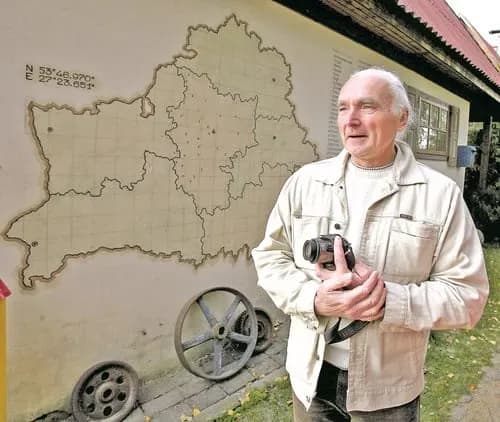
He is an artist by profession and works as a stained glass artist. He's also a restorer: he gives old things a new lease of life. And also a traveler: he does not get tired of developing and trying out new tourist routes around the country.
The acquaintance began on the phone. I knew that the ethnomuseum, which the master had created at his dacha, had the smallest windmill in Belarus. So I asked the owner how to get there. He also offered not only to take us there, to the village of Khodakov, near Minsk, but also to tell us something interesting about almost every exhibit.
Belarus is an immense travel space for Vladimir Tsvirko
The Mysterious Mirror
The first thing that surprised me was that there is no fence around Vladimir Tsvirko's cottage-museum. The host admits that he welcomes every guest, neighbor or stranger. Counts: How you treat people is how they treat you. In the five years since the museum opened, fortunately, not a single thing has been stolen from it, on the contrary, they are being brought. "Everyone comes back to me with gifts: people find unnecessary railways, chests, irons in attics and in grandmothers' storerooms, and they remember me," Vladimir Andreevich smiles. "Sometimes the owners of the given things come to visit later, they say that they look different for me.” That's understandable: Vladimir is an artist-designer and a draftsman-designer by profession. And he learned the secrets of restoration on his own. And now the old things in his hands get a second life. For example, two wooden wheels adapted for lighting fixtures hang from the ceiling of one of the rooms in the guest house.
He knows the history of almost every item he brings back from his many travels. There are also real legends associated with some of them, which the owner tells in a whisper. For example, about the mirror of the XVIII century, which belonged to the witch Ula: it was found somewhere near Rubezhevichi. She was also called a fortune teller, a woman who helped people and treated them with various herbs. This mirror is now in a mystical corner in Vladimir's house. Meanwhile, the owner says that he is not so much interested in old things as in their stories. He shows a wooden bucket roughly carved with an axe: "why isn't it finished? Could something have happened to the master? Time supposedly stopped in that bucket. There is always a mystery in every subject."”
Many of the items found in destroyed houses or landfills are transformed into real works of art in his workshop. And there, the owner believes, things get used to him, and he gets used to them. Today, Tsvirka is working on a wheelchair and some kind of driftwood, from which he plans to make... a staff for Santa Claus. By the way, the master works mainly with old tools, many of which are more than half a century old...
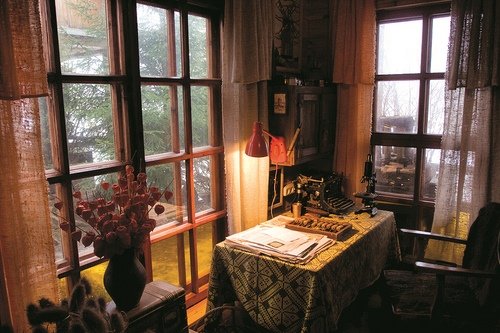
In the guest house at the cottage
We are slowly approaching chickenpox, perhaps the most unusual exhibit from the collection. "Come in! - the host invites you. - If you can still visit the real mill!"I immediately see a black and white photo on the wall. Probably the former owner of the windmill? Yes. It was Konstantin Ivanovich Zhitkov from the village of Mikitsk, near Drogichin, who built the mill in the 1930s. The whole village used it! After the war, in '55, this mill was still being restored, and in recent years it has been idle there. Parts of the structure were torn apart, and the wings were lost... And Vladimir brought him back to life, preserving the details as much as possible. "They used to grind corn flour on it," the master rejoices. - The pancakes turned out very tasty!”
At the cottage, everything is made by the owner's hands: a bridge over a pond, a gazebo, a house for Sonya's cat... According to his projects, two houses appeared -the master's and for guests - ”in retro style with country elements," as Vladimir Andreevich jokes. For example, elements of huge Soviet—era store counters (abacus in Russian) have formed whitewashes on the stairs, and a collection of embroidery designs, including pre-revolutionary and pre-war ones, are on the walls. There are also a lot of irons, inkwells, old Christmas toys, postcards... He seems to be collecting everything in the world. However, things are strangely ordered: each in its own place. There are also many films collected there. "Imagine how beautiful it can be to watch the 1963 film Paris from a Bird's—eye View in the attic," the owner smiles. "For adults it's like returning to childhood, but for children it's a curiosity.
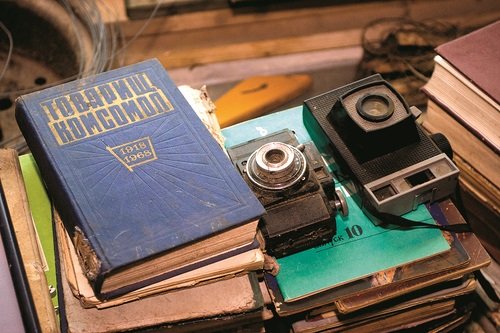
Whatever a thing is, it's an exhibit
A talisman for Khodakov
He likes to share what he saw, too. Therefore, Vladimir Tsvirko often shows his family and friends photos from interesting places in Belarus taken during his travels on a huge screen through a projector. He remembers: even as a child, he was looking for the lost library of the famous family near his native village of Ozerskoye in the Korelichsky district, and it was not far from the former residence of the Radziwills in the world. Further-more: Over time, he began to study the cities and villages of the country in detail. And today he is looking for interesting buildings, manors, and collects legends related to them. And then he compiles itineraries and guides around the country. He says there are already 150 of them.
Now Vladimir Tsvirko is also known as the author of the tour project "150 Golden routes of my Belarus“: last year he won the XI National Media Competition ”Golden Literature" with this book. And his photo exhibition was on display for a week at the Sports Palace in Minsk. Recently, he started the Ruins of Belarus project on his Facebook page. He says there are a lot of reviews. Sometimes the locals themselves tell you where to go, what to see.
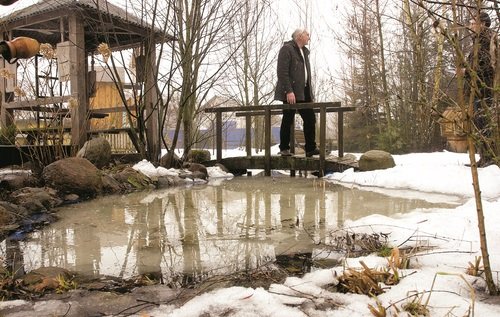
Everything in this ethnomuseum is made by the hands of the owner
He conditionally divided the whole country into ”islands" that can be thoroughly explored in one or two days. There are 29 of them in the Minsk region, 36 in Grodno, 28 in Brest, 24 in Vitebsk, 14 in Mogilev, and 8 in Gomel. There are 8-9 interesting monuments, temples, and natural sites on each route. "The paths were made up as conveniently as possible so that a person would not spend a lot of time searching," says Vladimir. - Because of that, there were a lot of difficulties. The Minsk region, for example, was "reshaped" three times. There is, for example, the village of Mokashichi: it didn't fit in somewhere. And the stone is so beautiful there, and even with a story. An evil aunt, according to legend, once sent her little niece to the forest to get firewood. On the way, the girl was overtaken by a thunderstorm. To hide, she ran up to the stone just as lightning struck it and knocked off a piece. It was under it that the girl escaped. The stone later began to resemble a chair, which is why they called it the "Paraski chair.“ So I couldn't leave the Moccasins off the route...”
Zwirka brings back stories from all her travels. And in the first travel booklet with four directions and maps of the Minsk region, recently published by the publishing house “Turinfo", there is a legend from the author. Others are being prepared for printing. In total, about 40 booklets are planned to accommodate all 150 routes. Vladimir doesn't stop: he gets time, he gets ready for the road. He says he needs two or three years to complete the project... He also develops themed trips: for example, "pyramids of Belarus" and "stones of Belarus". I got carried away with stone crosses in general: I even wanted to bring one for myself. However, he changed his mind: after all, the cross, he says, is a talisman of a certain area. Now, however, he is cutting down a stone cross himself - for a summer cottage.
Portrait of the master
Vladimir Tsvirko is a special person. He has a ” deep " purposeful look, confident energetic movements. His long hair, gathered in a ponytail, speaks about the creative composition of his nature, he dresses with taste. About himself, the interlocutor says: "if I'm doing anything, then I'm serious."” This applies primarily to his main job. And he produces artistic interior stained glass windows in the Tiffany style. He mastered the technology in his time in Poland, and in 1999 he opened a creative workshop in Minsk. Over time, he developed a personal style: his works are concise and soft. There are many foreigners among the customers. Vladimir Tsvirko charitably installed his stained glass windows in the Holy Trinity Church in the world, as well as in the Church of the Kazan Mother of God in the village of Berezhnoye in the Korelichsky district.
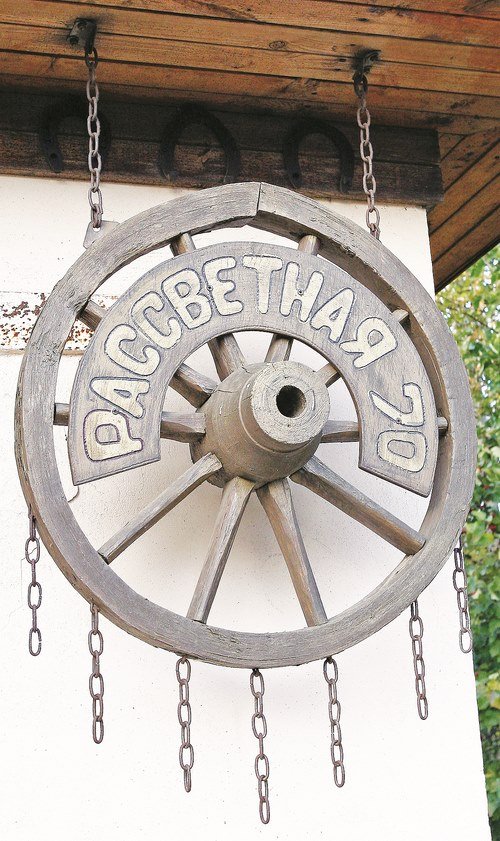
The address of the museum at Khodakov
He considers himself a happy man. He has a favorite activity (and more than one!), a job, and a family. His wife Anna runs a construction company and supports her husband in all his endeavors. He enjoys visiting the country in the warmer months: he grows cucumbers and potatoes, and plants flowers. Children-daughters Ekaterina and Tatiana, son Evgeny-are also frequent guests at their parents' cottage. "That's the success of parents," Vladimir is sure, "when children create their own lives. I always told them: If one of you becomes a millionaire, and someone else becomes a janitor, then I will help the millionaire. Because he used the opportunities that his parents gave him correctly. The children still remember those words"” His father proudly says that his Katya has found herself in music: she sings, writes songs, makes arrangements, Tatiana works in the field of trade, and Evgeny has become a good builder. Vladimir is also pleased with his grandchildren — two girls and a boy, for whom he is not just a grandfather, but a true friend. So Vladimir Tsvirko has someone to share his hobbies with, and someone to pass on his accumulated and hand-crafted treasures.
By the way.
This year, at the end of April, a one-day exhibition of Vladimir Tsvirko was held at the Sports Palace in Minsk: 30 of his photographs from different places in Belarus were shown. Representatives of the city authorities also offered the author a place for a longer exhibition: along Independence Avenue, near Chelyuskintsev Park. And in Gomel, the exhibition of his photographic studies is still open - until the end of May.
Ekaterina Medvedskaya