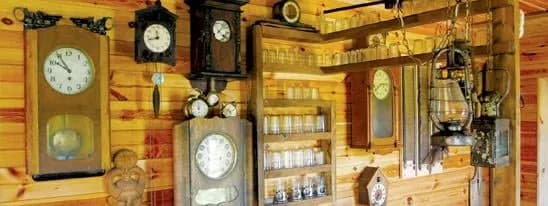
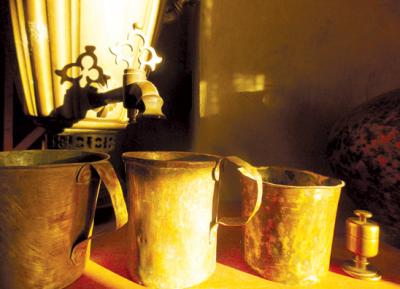
He brings back to life things that have been ruthlessly distorted by time, each of which has its own story. The objects in his collection come by different roads: some are found by ordinary people, others by antique lovers, and he brings others from his travels in Belarusian places. The search is long and painstaking. Irons, dishes, mirrors, plates, postcards, watches that have been exchanged for decades, of various sizes and shapes, flock to the private ethnographic museum near the village of Khodakovo, Minsk region, from attics, basements, dachas... He not only searches for exhibits related to memories based on their venerable age, but also restores them with jewelry precision.
The succession of generations
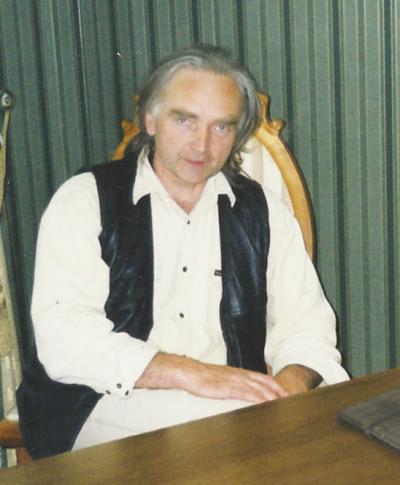
You don't usually have an honest conversation with collectors of rare old objects. They don't like publicity. Artist, stained glass artist, draftsman, designer, traveler Vladimir Tsvirko is opposite. The man is wide open. He can talk animatedly for hours about his exhibits, which he calls nothing more than a collection of stories and positive emotions. He remembers the way each item goes to his workshop. The objects are valuable to him as a memory and are very interesting from a historical point of view. For some, it's just junk, trash, trinkets that you can't even use for firewood.
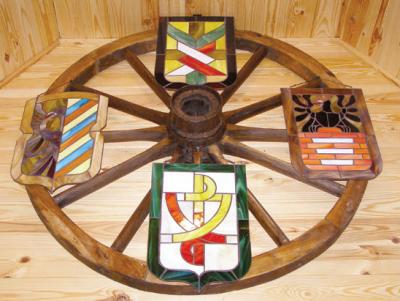
- Probably, such a reverent love for antiques was passed on to me from my grandparents. There were many talented, hardworking, educated people in the family, both on the maternal and paternal sides. After digging through the archives, I found out that my mother's relatives came from the famous noble family of Vysotsky. They had their own coat of arms of the Driya, which depicted three four-cornered stones marked with gold. Yes, my grandfather was a housekeeper for the Radziwills. My mother, who taught in elementary schools, knew four languages: Tatar, Hebrew, Polish, and Belarusian. I remember how, as a child, she told me a lot and fascinatingly about our ancestors: who was who, what they did. I saw how much my mother loved traditions and objects that preserved the memory of her family. For example, a box of chocolates brought by her brother from France... Somewhere, subconsciously, I began to treat subjects differently.
People say that old things keep the energy of their former owners, carry a bad aura, steal happiness and peace from the house, and spoil their presence. My interlocutor does not believe in such fairy tales. But what I'm sure of is that when you come into contact with an object, you can't think badly about it. Otherwise, all the negativity will go to him.
- 99.9 percent of the exhibits that are present here are household items. Well, what kind of negativity can they carry? After all, they created warmth and comfort in the house. I always believe that these things were done from the bottom of my heart by kind, talented and hardworking people. Take, for example, the same house wood carvings — lace windows. Why suffer and carve out all this beauty? But there is no. In this way, a person tried to touch the beautiful, to creativity. There was a good grain in it. Or else. I have a bread shovel with hollows in the handle. I show it to everyone and ask, What is it? They start fantasizing. It turns out that everything is simple. Earlier in winter, babble was thrown between the Balkans on the ceiling, a rope was threaded, and a stroller or a cradle was hung on it when the child grew up. Not only did the bread shovel perform its main function year-round, but it also raised children. Inevitably, these things arouse respect for the master who created them.
As for the old mirrors. There are also many beliefs about them... For example, I have a witch's mirror in my collection, but it's white. She treated the child with the power of words. There are only bright memories of her in human memory.
If only they could talk.
There are things of lasting value. They are treasured as a family heirloom. - Since I was a child, I remember that there was always some kind of story associated with the subject. And you immediately looked at the thing differently. Here, for example, is a box. She is related to a talented 8-year-old girl who was offered to study in Warsaw at the expense of the state, but her father did not let her go. Because in a family with seven other brothers and a father, there were more people to clean, do the laundry, and cook...
People often wonder why I need this "garbage", what will I do with it? I'll explain what I'll save for others. And the owner of the item immediately understands that this item will not be lost. Immediately, memories begin, he sits me down at the table, takes pancakes with fried eggs out of the oven and lets talk about the fate of a spinning wheel or a wooden spoon. After all, no one comes to the old people in the village for six months.
For example, I am deeply moved by the story about the wheels from a britzka from a village located in the heart of Nalibokskaya Pushcha. The former forester showed me the cart wheels that were in his barn. I said I could keep them for myself, otherwise they would rot here anyway. And the firewood from them is worthless. One word at a time. We started talking. He confessed that he had two more wheels in the attic. And he told me this story. One day, a wealthy man ordered a britzka from a local craftsman and made an advance payment. And disappeared. It was 1937. The master who received the money did not close the order. I made a wheel. And he ordered all his relatives that no one should touch them. Like, a person will come back, it happens, then I'll finish the job. The master dies, passes the wheels to his sister for safekeeping. As the years go by, they fall into the hands of a forester. I couldn't resist. I promised I could make a light. Silence. And then suddenly the owner: "maybe a person will come to the world after all ..." And this phrase gave me goosebumps.
And yet it's spinning!</3>
One day, Vladimir Tsvirko's childhood friend gave him a tempting idea. After looking at his wealth, he said that perhaps only the mill was missing. The idea began to take root. Moreover, Vladimir Andreevich has a long—standing relationship with wind turbines.
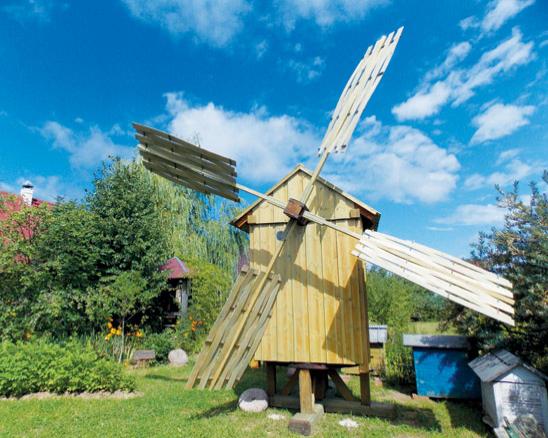
- Mom's sister married a miller. He worked at the old mill. And then the whole family helped him build a new one. I did a lot for my father, a builder. It was impossible to take your eyes off the huge four-story beauty that stood at the highest point in the area. I remember how I approached her. You throw back your head, wings slice through the air. It must be a living organism. In the mill, we hid from the thunderstorm, rode on its wings, and played hide-and-seek.
Once I went to Dudutki, then to Strochitsa. I looked at the mills. And for the sake of interest, he began to collect information about wind turbines, studied their designs, and quietly made drawings. In general, I got the idea to make a miniature windmill, say, 1:3. and so luck smiled at me. Kind people suggested that an old mill lives its quiet life near Drogichin, which began to be built back in 1938. It was practically falling apart. He immediately rushed there.
I got to know her owners. He convinced me that it would take months of painstaking work and this mill would be as good as new. All the insides of the mechanism have been preserved from the original structure. A familiar forester helped determine the types of wood. The mill has been restored and restored from exactly the same types of wood, the same size as before.
There was a glimmer of hope in my soul that it should turn around. And one morning, a miracle happened. I enjoyed it like a child.
At the moment, it is the only one of its kind, the smallest Kozlovka windmill in Belarus.