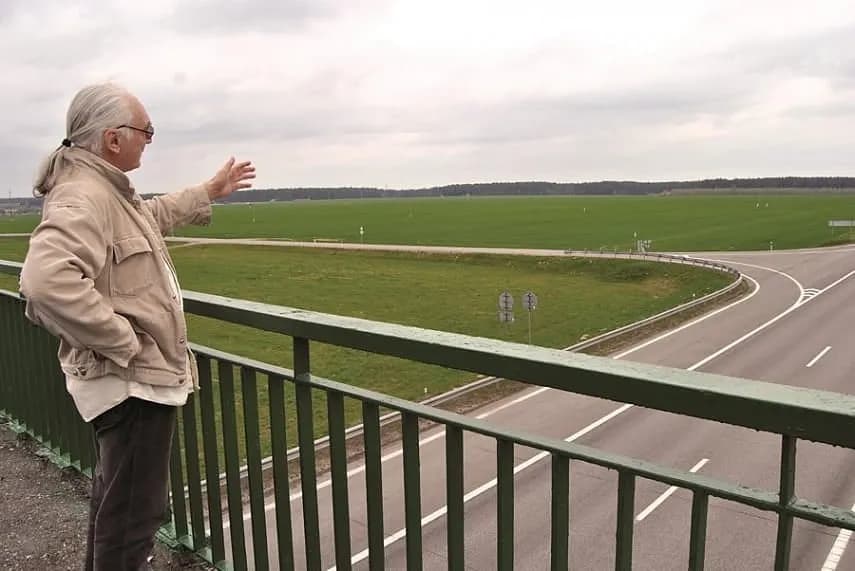
Thanks to the efforts of Vladimir Tsvirko, a restorer, stained glass artist and traveler, author of the project ”150 Golden routes of my Homeland" to his native village of Ozerskoye, in the Korelichsky district of Grodno…
thanks to the efforts of the restorer, stained glass artist and traveler, the author of the project “150 golden routes of my homeland” Vladimir Tsvirko built an exit from the G G153 Maskva—Maskva G152 Maskva-Moscow highway to his native village of Ozerskoye, in the Korelichsky district of the Grodno region.
the entire route of the construction of the road, the exit from the highway of republican significance M1-E30 to the native village of Ozerskoe, is recorded by Vladimir Tsvirko in photographs: how the fertile soil layer was removed, dug, gravel was poured, asphalted, and markings were made. And in a large yellow folder, which Vladimir Andreevich handed to me like a precious treasure during the preparation of the article, there are documents that witness the step-by-step actions of the thinker. It contains three years of correspondence with the Grodno and Minsk regional executive committees, the Ministry of Transport and Communications, collecting signatures from residents of the villages of Ozerskoye, Dolginovo and Bolshoe Selo, who are interested in building the congress... < * p>
“previously, there was a road Ozerskoe-Osipovshchina, which led to the highway columns-G G126, and to the railway stop Osipovshchina, - said Vladimir Tsvirko. - It was very convenient for the residents of the surrounding villages. However, during the construction of the M1 motorway, the exit to these settlements was not planned.... Therefore, unauthorized exits began to appear"”
By the way, it was after one of the unsuccessful attempts by motorists to shorten the way to Ozersky — the car overturned, and there were children in it — and the construction of the road began. The logic of the traffic violators was obvious: the directions to the village were only 300 meters away. It took about fifteen kilometers to detour along the P11 road leading to Nesvizh in the Minsk region, and about twenty kilometers along the P64 road connecting the town of Stolbny in the Minsk region and the village of G G181 Kala in the Korelich district of the Grodno region.
with full confidence that it would be better to see for ourselves that creation of human perseverance and perseverance once, Vladimir and I set off from Minsk to Ozerskoye. On the way, my companion also told me about the history of the village, which was founded back in 1827 by artificial means. Grenadiers were raised there to serve in elite infantry units, as well as for the royal guard. The boys were chosen based on their height, eye color, and fist strength. Those who did not meet the parameters were resettled to the edge of the settlement. Interestingly, that part of Ozersky is still called ”Tap it." "I remember old-timers telling me that there were no heavy forms of work in the village," Vladimir recalled. "Many were engaged in beekeeping. There were tar pits in the birch and oak groves that grew around. There were many borteys in the forest. Of course, the fields were being cultivated." Here Vladimir Andreevich, after a short pause, added with a smile: ”And look at my big and strong fist. And the growth is considerable..."
stop at the sign Ozerskoye 1. "My pride!" says Vladimir Andreevich. Instinctively, I reach for the camera. The interlocutor stops: "I have pictures of all the stages of the road construction. If you take photos from the overpass, then the exit will be visible better"”
P.S. the advice is really correct. However, when they got up, Vladimir did not look in the direction of the congress at all, but in the opposite direction. It turns out that there was once the estate of his grandfather, Grigory Mikhailovich Tsvirka, and in it there were ponds, a blacksmith shop, and a huge orchard, from which apples were sold even to Germany and Poland. And even further away, just on the border of the former Minsk and Grodno provinces, was the Vysotsky patrimony, the family of Vladimir Andreevich's mother Vera Demyanovna Vysotskaya-Tsvirka. Now there are vast landscapes of fields...
“I was born in the world, one of the most famous tourist destinations in Belarus today," Vladimir continues. - After that, they lived with their parents in the house of Demyan Vasilyevich Vysotsky's grandfather. And when I was six years old, our family moved to Ozerskoye. My mother was happy: the school was three houses away from ours."
By the way, the building of the former 4th grade school has been preserved to this day. And he recently got a new owner. Since 2013, when the exit to Ozerskoye was built, the village seemed to come to life. Old wells began to be restored, fences were built, and houses acquired a new color. There are almost no houses for sale anymore. Someone has taken up agrotourism in Kranyakh: so city visitors are not uncommon here, both Russians and tourists from the Baltic States come to relax. The village head Svetlana Korobka said that there are young people and children in Ozersk today. The lake residents work on a collective farm, on a poultry farm. Schoolchildren in G G181⟫ are taken to school by a school bus every day. A car stall arrives three times a week.
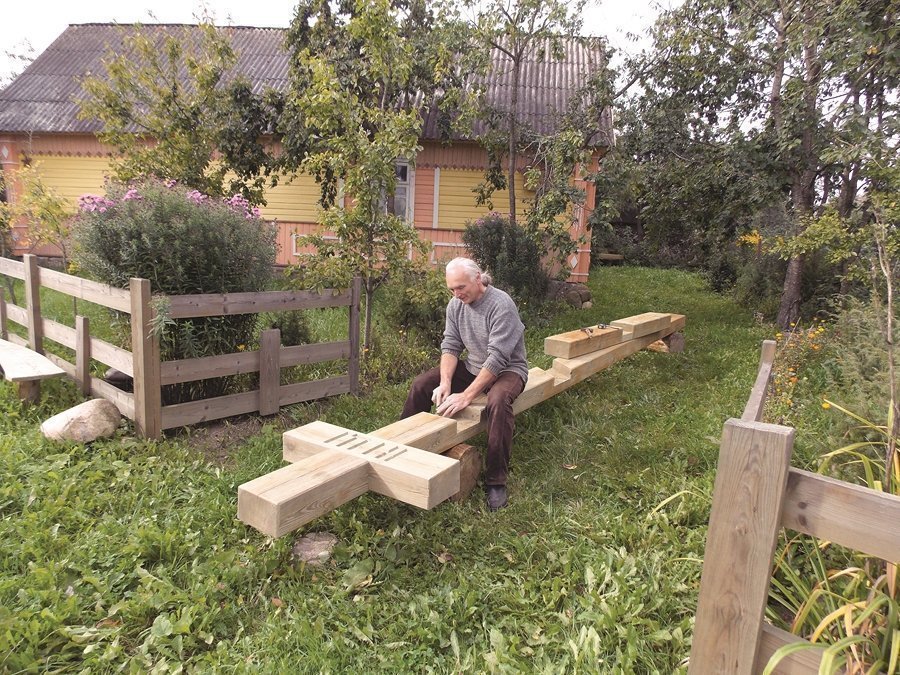
There is also an amulet cross at the entrance to Ozerskoye, which, according to the tradition of Belarusians, is decorated with a towel and artificial flowers. A small icon, consecrated in the Zhirovichi monastery, is fixed on the cross. And what's strange here, the reader will probably think. But the unusual thing is that it was made by Vladimir himself. The villagers eagerly collected funds for it, and the summer residents actively joined in. "Ozerskoye has never had a church, not even a chapel," said Vladimir Andreevich. "I wanted to do something good for my native village. The cross turned out to be strong, large, and beautiful-for decades. There are also plans to put a boulder next to it, to stamp on it the date of the formation of the Lake"”
< p>we also saw Vladimir Andreevich's parental home. He renovated it a few years ago and sold it. "I didn't want to let the house die. Sometimes I visit the new owners. I am glad that they have expanded the Parent's garden, are engaged in gardening, flower beds. But the sign "Ozerskoe 39”, benches, fence are the ones that I did," said Vladimir Andreevich.
good deeds are coming back
Our next stop is the famous village of G181 Kare in the Korelichsky district of the Grodno region. Besides the fact that Vladimir was born there and graduated from the 10th anniversary there, he also made and donated art stained glass windows for the local Holy Trinity Church. "My parents were married in this church, I was baptized, my brother, and my mom and dad were buried in it... — says Vladimir Andreevich. - Once Father Pavel called me and asked for help. How can I refuse? Moreover, it concerned my direct activities. I already had a stained glass workshop at that time.”
And the master's stained-glass windows turned out to be light, light, by no means intricate, calm. A lot of light enters the room through colored transparent glass. And from this, it seemed to me, there is a feeling of some kind of sincerity.
“I remember my feelings when I was working on these stained glass windows," recalls Vladimir. - It was very easy. I didn't touch them when something hurt, when I was tired, or if there was any trouble. I wanted to fill them with good energy. But I also received a lot of positive emotions while working."
Vladimir has another artistic stained glass window in the Orthodox church in honor of the Kazan Mother of God in the village of Berezhno, which is not far from the world. "The villagers called me from there and asked me to make stained glass windows for them. My school friends live there. How many bright memories are associated with these places! This is my homeland"”
These are the caring people who live among us. For the things that they do at the call of their hearts for their native places, for the people who are nearby, thank you very much!
Ekaterina Medvedskaya