
Since it became fashionable to travel around Belarus, something has been done to help travelers. Almost every reputable newspaper has received a " travel" column outlining the routes.
Only the laziest tourist town has not issued postcards and maps indicating cultural sites. Only the most negligent tourist didn't get a navigator.
And do you think every Belarusian has discovered Belarus?
Like every traveler, architect and designer Vladimir Tsvirko's passion for photography began with a modest two or three hours of photo hunting for cultural and historical delights.
— But when, after such outings, I showed photos to friends and acquaintances, they were surprised: "where have you seen this?". When I brought the photos from Drivyat, they told me: "This, brother, is not Belarus, but Lithuania or Poland." By God, it was a shame. When those same friends went on a trip by themselves, I asked on my return: "Well, where have you been? Have you seen it?" I've heard the standard answers, like:"In Nesvizh." "Did you stop there on the way?" —"No." And my traveling friends, after talking with me, went on a new trip! And upon our return, we have already stated: "Volodya, you won't believe it. We were on our way to G129⟫, but we didn't get there. I've seen so many things! It's awesome, super, super, cool!"
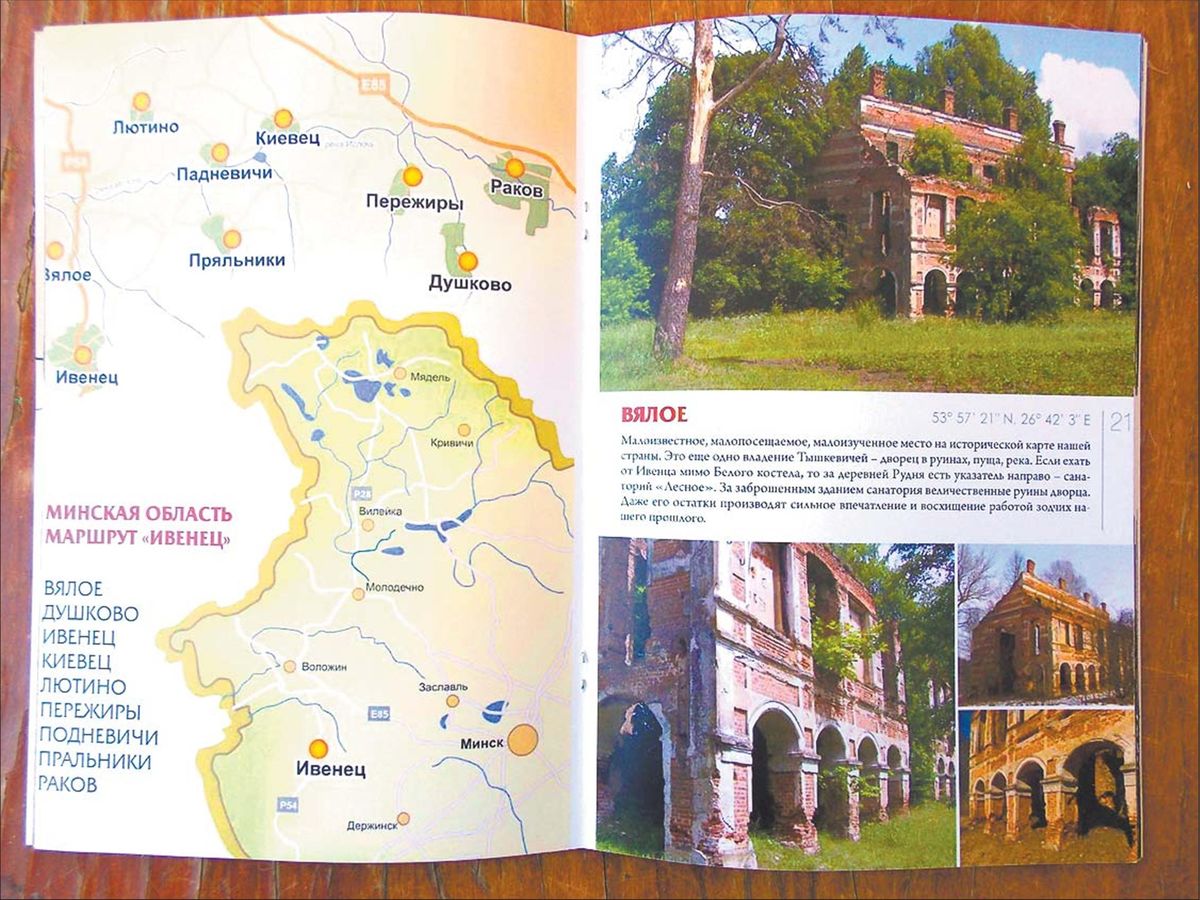
He was strongly attracted by the fact that, with a sincere desire to see the beauty and greatness of Belarus, Belarusian tourists go to "promoted" places and do not see what lies under their feet along the way. They didn't give up going over the hill. I didn't have enough imagination to walk past the cemetery. Indeed, returning from a trip in which most of the interesting things were simply missed just because nothing was known about them, and then, when both time and fuel were irretrievably ruined, suddenly they were pressed, it was incredibly insulting. To see in a photograph what a few hours ago could have been observed with one's own eyes is to put the audience in a state of shock. These circumstances prompted traveler Vladimir Tsvirko to develop regional routes and create a series of brochures "150 golden routes of my Belarus." Each brochure contains nine items that cannot be missed, with photos and descriptions.
- I worked on the Minsk region as a testing ground. I drove by, watched, filmed, recorded, then drove by again, in a new way: I could look at the same objects through the eyes of different people from different places. It's not like we can measure Minsk from the navel of the earth. A traveler can travel from Brest, or Grodno, or Vitebsk. I was advised to set out the routes. But there are maps and navigation tools. And a rare object is not indicated by coordinates. My project has another goal: for a traveler to open a brochure and have a choice. For example, the proposed route consists of nine points, and he can say to himself: "I will cover only six. Or three." This is a project for adventurous travelers, not tourists who are tied to a bus and a guide, without the right to influence the route.
Belarusians go to "promoted" places and do not see what lies under their feet along the way.
Why 150? It's just a beautiful number. However, it is not divided into parts. It's just that the author of the project really wanted it to be like this: you come to a region and you don't get out of it, you don't really review everything, you don't touch it, you don't paraphrase. And then you can definitely brag that you've seen everything in this area. How can this be achieved? The excellent manual by Anatole Fedoruka is exclusively about homesteads. The exhaustive "Globe of Belarus" by Andrei Dybouski does not have the right system. I wanted to create a product for practical use. Literally. Even the size was assumed from this.
- The publishers offered me to publish a folio. All the most interesting and beautiful things under one cover. But you have to understand that this is not a product for a traveler. It's something like a library, souvenir, or gift. Put it on the shelf, give it to the foreigner. You can't develop tourism with folios.
Vladimir Tsvirko wrote a legend for each route. Friends once read his story about a lame mare, and they ask, "Tell me, was that really the case?"He answers them: "It doesn't matter." And this "lame mare" was born to him in two words. He found fault with a certain man who lived by the mill, with the singing that was connected with that mill. MO what a mystical story, mo... "Come on," he says. "The mill is like a mill, leave it alone." "Has no accident ever happened to love?" Vladimir did not stop. "Nothing happened! There was only a Lame mare""
"But that's another question," Vladimir changes the tone of the conversation. - What legend is unfolding in front of you?
I answer by looking at the brochure: "the threshold with serifs."
"Oh, it's about werewolves. Their baby turned into a wolf cub...
Svetlana Denisova