In the history of Belarusian cinema, there is such a well-known television series "Ruins shoot ...", directed by Vitaly Chetverikov at Belarusfilm in 1971 based on the documentary novel by Ivan Novikov ”Ruins shoot at point blank range". Both the series and the novel are dedicated to the heroes of the Minsk underground during the Great Patriotic War, with such famous heroic figures as engineer Isai Kozinets, military officer Ivan Kabushkin, student Vladimir Omelianyuk, and others at the center of events.
The notes below are not about those ruins at all. But they're still the same... about the ruins. This word will be a key word in many ways in our hero's story, and the reader will quickly understand why it is so. These are the same ruins, but they are not shooting, but are helpless, asking for human help, or, conversely, asking a person not to touch them, not to disturb their eternal sleep, exhausted by insomnia.
Ruins that don't fire... and they ask not to shoot at them.
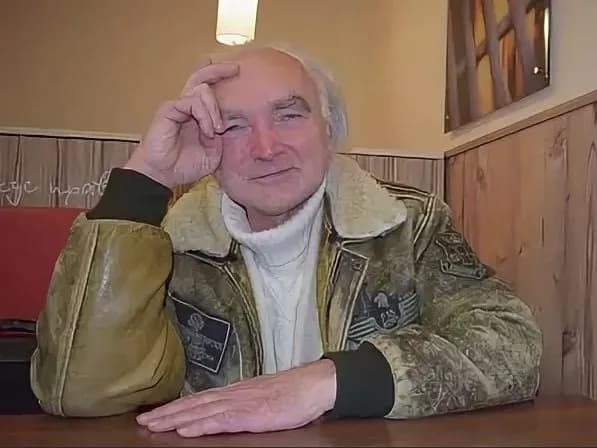
Our Saturday guest today is Vladimir Tsvirko, a graphic artist, photographer, designer, stained glass artist, restorer, traveler, local historian, researcher of history and historical architecture. The man is absolutely unusual. A man who has traveled the length and breadth of his native and any Belarus, recording literally all the architectural and ethnographic traces of our past, the landscape features of our land. A man who has developed as many as 200 tourist routes in Belarus based on his own travels. A man who has created a unique ethnographic museum in his own country house near Minsk, where it is not a shame to bring guests from abroad. A real obsessive. A patriot, not in words, but in deeds. A person is a project.
Today and until January 28, the Presidential Library of Belarus hosts a photo exhibition dedicated to the Year of the Little Motherland by Vladimir Tsvirko's author's project “Silhouettes of heritage". These silhouettes are represented here by images of churches and churches, castles, monuments of palace and park architecture, unique in their beauty and history. In fact, in the 41 photos presented, you can see the entire historical Belarus with the features of the ancient architecture of all regions of the country. Students, schoolchildren, teachers, and often representatives of the deputy corps come on a daily tour (fortunately, the Presidential Library is located in the Government House), and Vladimir Andreevich willingly conducts guided tours for them, telling them about specific objects-images in photographs, and about his travels, and about his museum, and about the history of Belarus, about his understanding of this history and Belarus itself.
We also did not refrain from asking Vladimir Andreevich a number of questions about all this and more. His answers were special detailed monologues, which we are introducing to our readers today.
My photo exhibition appeared in the walls of the Presidential Library both by chance and not by chance. Once upon a time, the National Historical Museum showed the final exhibition of an art studio from Slutsk. The young members of the studio created their drawings based on my photographs. And the staff of the presidential library saw these children's works, then, of course, went online, looked at my originals, generally got acquainted with my projects, the topics I'm working on, and got the idea to make my photo exhibition on their site. By the way, it's great that they also use the library square as an art venue where artists, graphic artists, and photographers exhibit, because books are certainly good, but if you add an art exhibition, you get a multifaceted perception of the world. Artistic and creative versatility. Besides, it is important that there is a deputy corps nearby, and our deputies often come here. And they also have the opportunity to get acquainted with art and history here. And there is no need to be shy at all that someone, even a deputy, may not know something from history or is not knowledgeable in some area. Today, I can say with confidence that we all don't know our Belarus in full. It may be impossible to fully know it, it is impossible to fully explore it, but most of us have no idea how diverse it is, how unusual and beautiful our Belarus is.
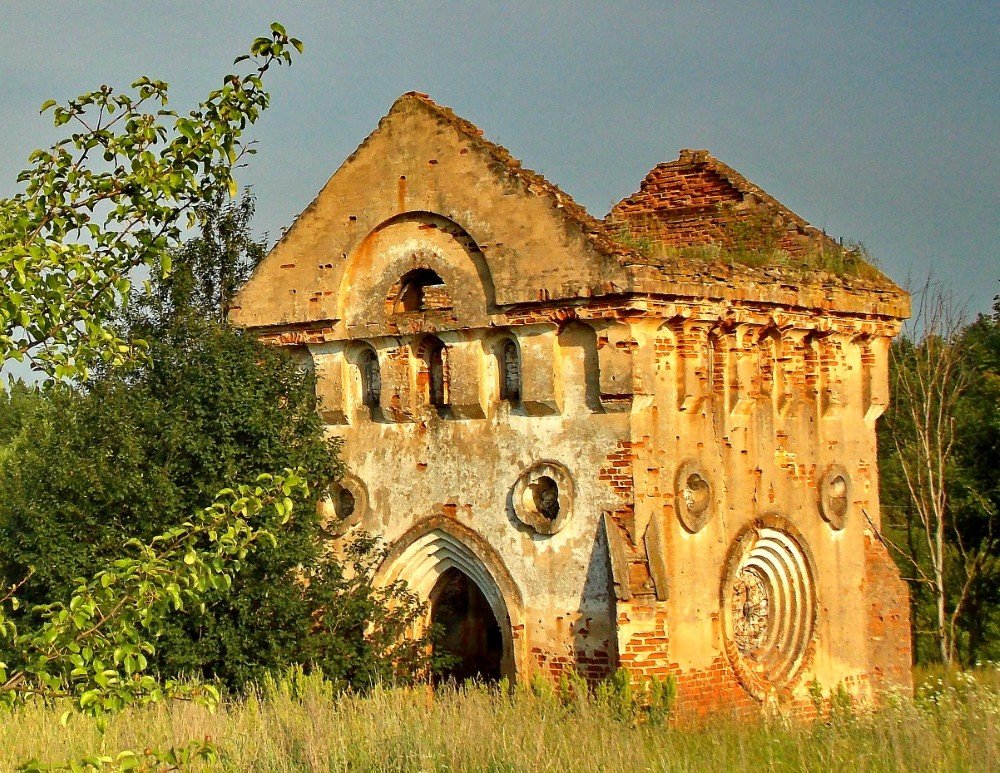
G6, In Reverse. Chechotov Manor. Refrigerator. 1836.
It should be understood that we have very few architectural monuments left from the number that we had before. Statistics show that only 3 percent of them remain. And when you think about this figure, you can imagine how unique Belarus was and how much of this uniqueness we have lost. You're traveling, you drive some 5-7 kilometers, and here, it turns out, there was some kind of architectural building, you drive another 5-7 kilometers, and there was something, you drive more, and here, thank God, the architectural monument has been preserved... it doesn't matter if it's a religious building, a palace, a manor house, a chapel, or a castle. This is all our story. As for castles, it is no coincidence that in the past Belarus was called the country of castles. And, mind you, we didn't name her that way because of our ambitions. That's what the Europeans called us, despite the fact that in Europe itself, too, the castle is locked. But they called our country the land of castles because there are an incredible number of castles in our relatively small territory. There were about 125 of them on our land! It was a truly fabulous country, full of castles. And even more unique is what has been preserved. Every time I conduct field trips, I tell the students about it. Why is this object unique? Yes, because it is like this in a single instance: both in its architectural style, and in its biography, and in its fate (how it was built, who built it-there may be such a list of European architects!). And this applies to literally all architectural monuments, from castles to small chapels. These are all unique objects that we have to wrap up in the palm of our hands like this and blow on them like a baby, take care of them.
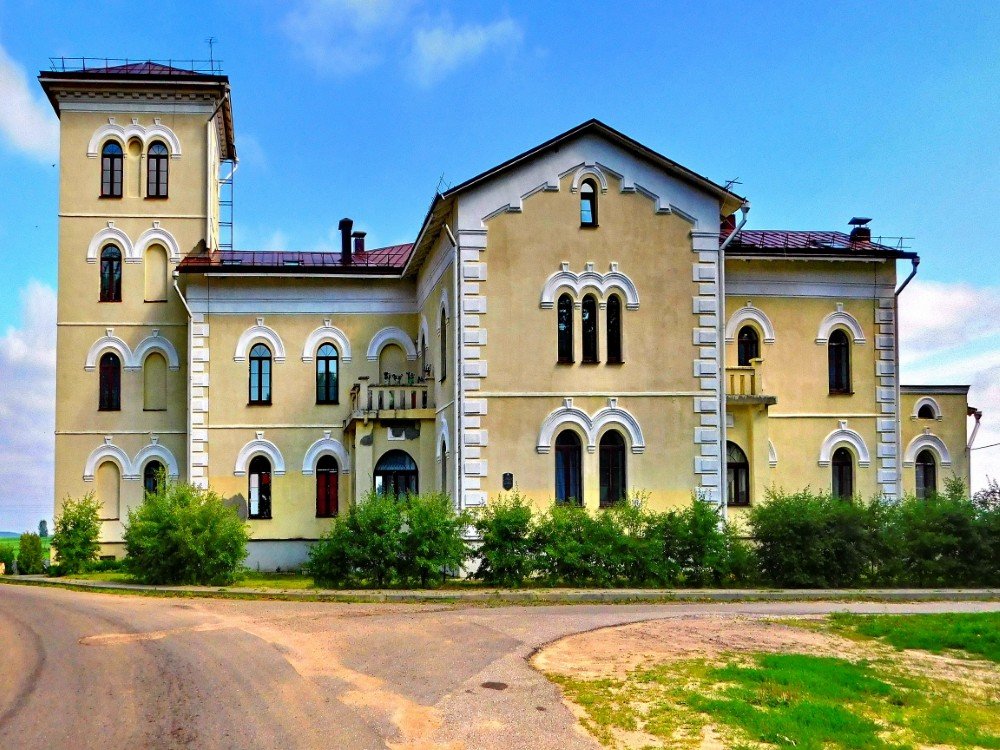
G G6⟫, Tarnova. Mavrausov manor house. 1884.
I have two educations: a draftsman-designer and an artist-designer as a stained glass artist (I am engaged in art stained glass in the Tiffany style — a rather rare and not yet very popular art form, but nevertheless, it lives on).
And how did I come to all this, shall we say, history? It just happened. Since childhood, and I was born and raised in our famous world, I liked guerrilla warfare. I mean, there was something like a Robinson Crusoe in my soul. I really liked all these ruins, ruins, and old buildings in general. Of course, back then, in my childhood and youth, I did not consider all this as some kind of architectural monuments, as some kind of ancient exclusive, some kind of unusual or valuable. No! I just saw it as something fabulous, mysterious, based on legends. But I grew up in an intellectual environment. And my grandfather collected the library, and my dad, too, and my older brother, and then myself. Our house was always full of people, and children were present at these gatherings, and we kids could listen to a variety of legends, stories, even horror stories, they say, there are ruins there, and some kind of ghost lives in them. So gradually the forbidden fruit was born. And the forbidden fruit is so attractive, so intriguing! And my friends and I certainly went to those ruins. That's how it all started.…
Later, when I came to the city, when I finally matured, I began to travel a lot, and like any normal curious person, I always had an interest in one or another new architectural object that came my way. Moreover, I paid attention to him as an artist and graphic artist.
Architecture, its plasticity, they are graphic in themselves. And I really wanted to create something similar to Watman. He was drawing something there with a feather... and all this was imperceptibly dragging on.
And over time, it has already become a kind of natural constant need to go exactly where I have not been yet, where I have not seen anything yet. I began to purposefully make photo archives. Moreover, I shot not only architecture, but also unusual natural objects (old oaks, boulders, etc.). By the way, the photographs helped me a lot as an artist during the den (that's what I call the winter time, when you bury yourself in your studio, as in a den, put any image of the temple on the screen with a projector and work). It was convenient and cool. Although, to be honest, I treat photography as a special trick. The camera will never replace nature. That's why artists don't sit still, they actively go to the open air.
Returning to the question of travel itself, over time, there came an understanding of the need to know something about this or that object before going to it. Know the history of its origin, the history of its life, decline, and rebirth. This made me start my own library (perhaps the most valuable in this sense, I consider the books of Anatoly Tarasovich Fedoruk), rummage through second-hand bookstores, and go through the archives myself. I did all this in order to be prepared when I came to the site to really see it.
And today, indeed, I can unequivocally say that there is not a single corner of Belarus where I would not be, where I would not take pictures. However, I may have underestimated something. And I will still be filming these places. For example, if city take is Grodno, Vitebsk, Mogilev... As for such local objects, I would also take pictures, for example, of the Oginsky estate in Zalesye, because at one time I photographed it in ruins. And today there is already "gloss and shine". So, we need to go now and take off the "gloss and shine".
When you come across a restored object and see, say, modern plaster, and in some places even siding on an 18th-century or mid-19th-century object... It's just blasphemy, I think. And there are such examples.
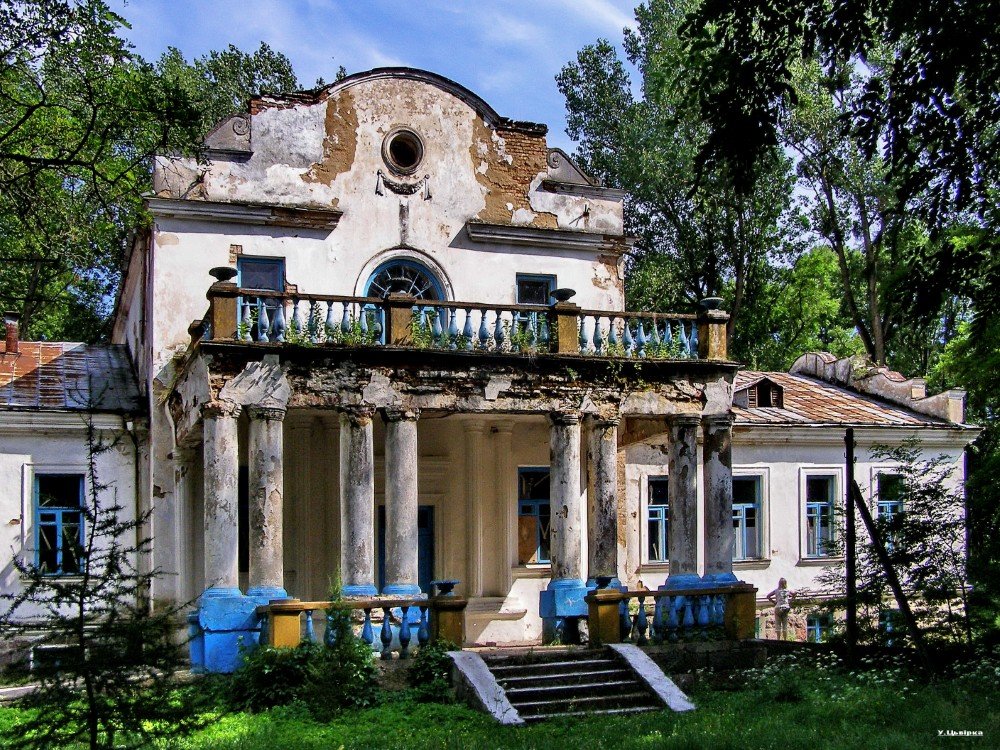
G G6⟫, Saveyki. Novitsky Manor house. 1850.
Our famous restored... G181..., ... G129 ... ... to be quite clear, what was done there does not suit me more than it suits me. But we're just learning all this, and it's never a shame to learn. If we were told today that we can do everything, it would be nonsense. And my reproach regarding peace and Nesvizh is not categorical, it is not continuous. I like Vysotsky's statement in this sense. When he was in America, the bourgeois Americans asked him a question, knowing his biography, character, and views: “are you really against the Soviet government?"To which Vysotsky brilliantly replied: " I don't mind. I just want to be even better"” And that was the end of all the interviews with him ... It's the same here. In no case do I want to grumble, they say, everything is poorly done. You just need to learn and admit mistakes. And if we admit mistakes, what do we do? We fix them. It's like a regular school practice-working on mistakes. But it's already great that we're going down this road.…
The situation with Kreva castle is both a laugh and a sin. Somehow, information passed, they say, they ran out of stones there, and now the whole country needs to collect them and take them there. Someone has assembled a trailer of rocks. And I'll go there in the spring: I'll bring as many stones as I can into the trunk. But that's not the point. I just don't understand why it happened that we have to collect stones as a whole country. There is, of course, a metaphor about the time when you need to collect stones. And such a time has really come. But in reality, these stones should have been placed above those castle walls from the very beginning!
Based on my travels, I implemented the project ”200 unique tourist routes in my Belarus". Each route includes 9-10 points, designed for a day or two days. These routes have already been tested, people drive, then call.…
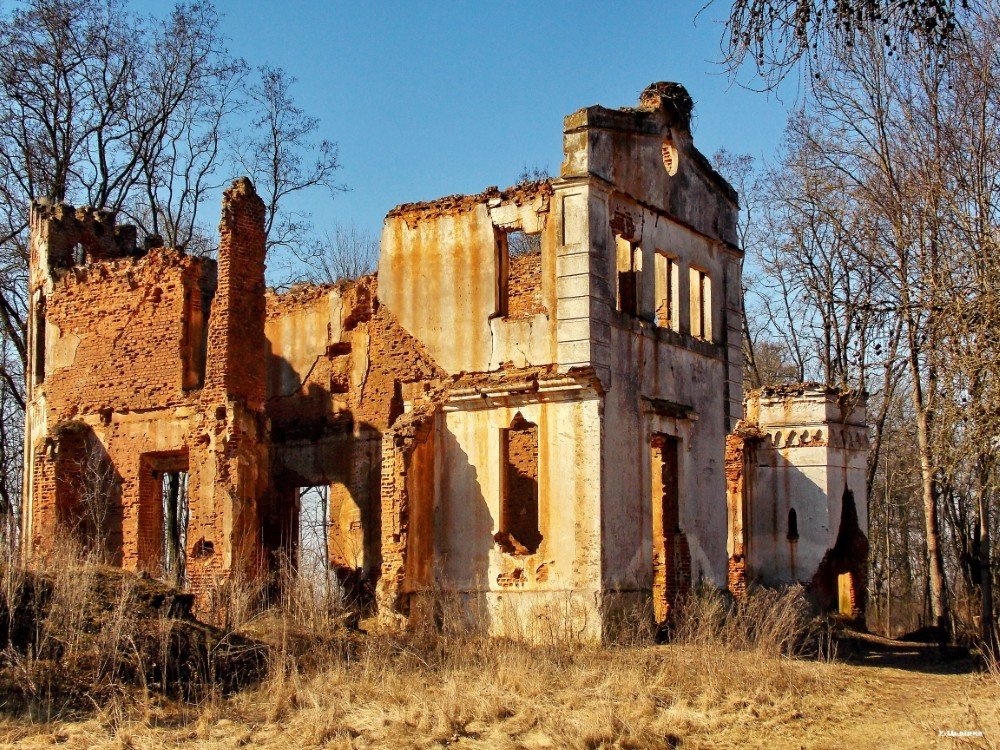
G G2⟫, Supernumerary. The Narkevich Palace-Yodko. The year is 1788.
I am often asked, which region is the most interesting in terms of architecture? I answer unequivocally that Grodno region is rich in terms of the number of architectural monuments. There they are restored, restored, have good care, and even if they are in decline a little, but the area around them is in flowers, everything is cleaned... I would put Brest region behind Grodno region, especially the one near Baranovichi. Then Minsk region, then Vitebsk region, which is especially interesting for its surroundings, terrain, many large and small lakes and rivers. And the people there are unusual, it's just a fairy tale. Well, Mogilev region and Gomel region complete my rating. Especially those areas bordering Russia. They are very damaged. There is very little architecture left there, but on the other hand, there are a lot of ruins, which is also interesting for me. Ruins can sometimes say much more than restored objects.
One day, my friend Margarita Arnoldovna Gogoleva contacted me. She moved to live and work in Germany and asked me to show her German friends some unusual route through Belarus, so that I could show them our country from an unusual side. They had seen Jan's G181 and G129 before, and they wanted some kind of Belarusian exoticism. And I showed them. First, the restored Zalesye, as an example of the direction in which we are working in terms of restoring our local monuments, then G G63 Yak, as a small, compact place with its own unique history (of course, I also told them about the Smorgon Bear Academy), then Soly with its unique architecture. The penultimate and last points on that route were G G160 i and G G63.. But even before G G160⟫, I decided to bring guests to Novospask-it's between Smorgon and Krevo. There was once a huge Uniate temple there, but today it is in ruins. Margarita told me the day before, “Maybe we shouldn't show them those ruins.“To which I said, "Let's show you! Let's see how they will react"” You should have seen how much the Germans admired those ruins, how they walked back and forth there, touched them with their hands, took pictures, and bombarded me with questions about what and how. They were interested in literally everything! They were most interested in the ruins of that traveler, because it is authentic, real... and by the way, there was an architect among those Germans. So much for the ruins…
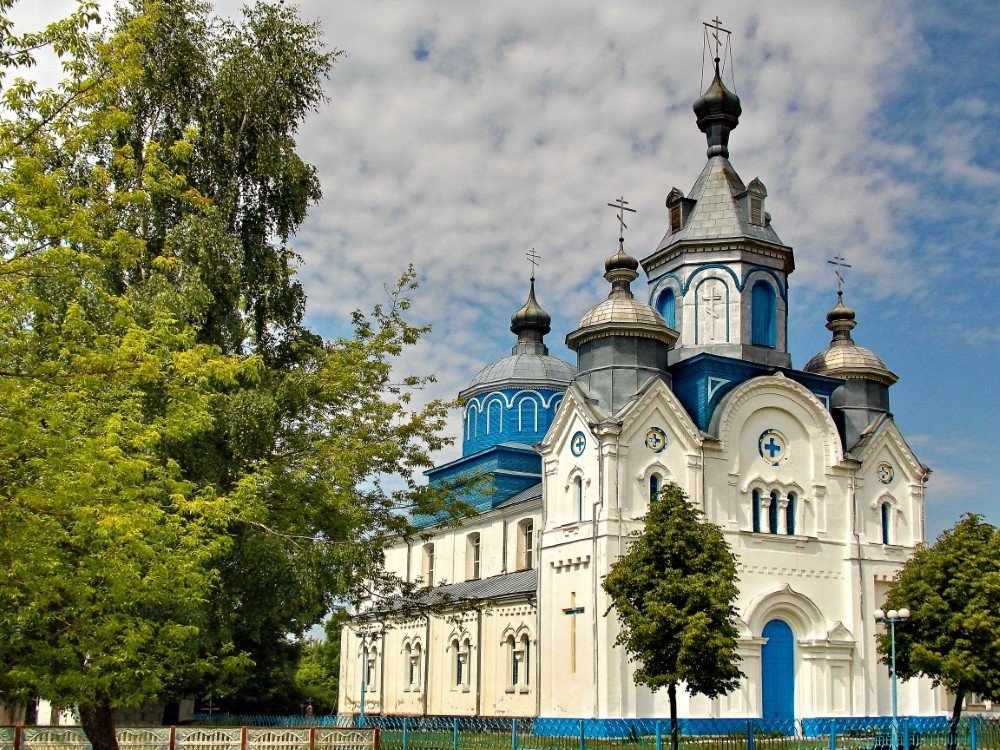
G G10⟫, Krivoshin. Church of the Intercession. The year is 1740.
What is our Belarus like more? Orthodox? Catholic? Gothic? Squat? We have everything: towering Gothic Catholic churches, and squat typical Orthodox churches, the so-called Muravyovka, by the way, a unique example of typical construction of religious sites. Although our architects still tried to add something of their own to these typical churches: either to make a window somewhere in their own way, or to put up some kind of tower or bell.…
In general, our Belarus was once very diverse and multifaceted. I remember my childhood in the world. I had friends who were Poles, Tatars, Jews, and even Germans. Belarusians, Russians, Ukrainians — it goes without saying. I've seen their culture. For example, I really liked Jewish culture, because Jews were constantly joking, laughing, and telling jokes. I just liked that they were funny people... Later, when I grew up, I seriously thought about it.: it was so much to endure and manage to stay cheerful, to compose jokes primarily about yourself and tell them to everyone.
It is impossible to even imagine how diverse our Belarus is. You have to see that. Most of the time, we look at everything superficially. Let's go to a certain village and see what the Orthodox church is worth. Well, it's worth it, and if we see an Orthodox cross at the entrance, then we generally close the question about this village to ourselves: everything is clear, Orthodox. But one has only to dig deeper, and it turns out that a church of extraordinary beauty once stood opposite the church. And there, further on, is an educational Jewish building. And even further away was Tatarskaya Street, which was called Tatarskaya Street because it was inhabited by Tatars. And then we ask: How did they get along on one piece of land all together? Even today we are surprised by this, because it is really interesting-this tolerance, this intertwining... Of course, in a sense, Jews were separate, Tatars, Poles, and Belarusians. But all the same, they lived so closely, so well, and so peacefully that if they even quarreled, it was only because of the border. Similarly, a Belarusian could quarrel with a Belarusian from abroad! But they never quarreled because, they say, I'm a Belarusian, and you're a Jew or a Pole, so you're inferior to me. Of course, there were pogroms, no one disputes, but these pogroms, it seems to me, happened only when politics intervened in people's lives. But in fact, people of different nationalities and different faiths lived peacefully on our land, they were like gears in a single clock.
Let's go to a certain village and see what the Orthodox church is worth. Well, it's worth it, and if we see an Orthodox cross at the entrance, then we generally close the question about this village to ourselves: everything is clear, Orthodox. But one has only to dig deeper, and it turns out that a church of extraordinary beauty once stood opposite the church. And there, further on, is an educational Jewish building. And even further away was Tatarskaya Street, which was called Tatarskaya Street because it was inhabited by Tatars. And then we ask: How did they get along on one piece of land all together? Even today we are surprised by this, because it is really interesting-this tolerance, this intertwining... Of course, in a sense, Jews were separate, Tatars, Poles, and Belarusians. But all the same, they lived so closely, so well, and so peacefully that if they even quarreled, it was only because of the border. Similarly, a Belarusian could quarrel with a Belarusian from abroad! But they never quarreled because, they say, I'm a Belarusian, and you're a Jew or a Pole, so you're inferior to me. Of course, there were pogroms, no one disputes, but these pogroms, it seems to me, happened only when politics intervened in people's lives. But in fact, people of different nationalities and different faiths lived peacefully on our land, they were like gears in a single clock.
What is the most unique exhibit in my private ethnographic museum? It is very difficult to answer this question. But, apparently, it's still a windmill. The smallest windmill in Belarus, twenty meters by twenty meters and about three meters high. It even has the official status of the smallest. It stands on the site opposite the museum. It's in working condition. I brought him from the village of Mikitsk, Drogichinsky district. This is a truly unique exhibit, although before and even after the war we had a lot of such small windmills. They could serve only one or two farms, while large wind turbines with four floors could work for 5, 10 farms, or even for an entire region. Why were they so big? Yes, because, firstly, there were a lot of villages, and secondly, the villages were not the same as they are now. Today we are not surprised when there are three people living in a village, whereas before they could number fifteen hundred inhabitants. And the families were not like they are now. At that time, it was a father and mother, a grandfather and a grandmother, and, say, 16 more children. And uncles and aunts with their children could also live together. That's what a family was.
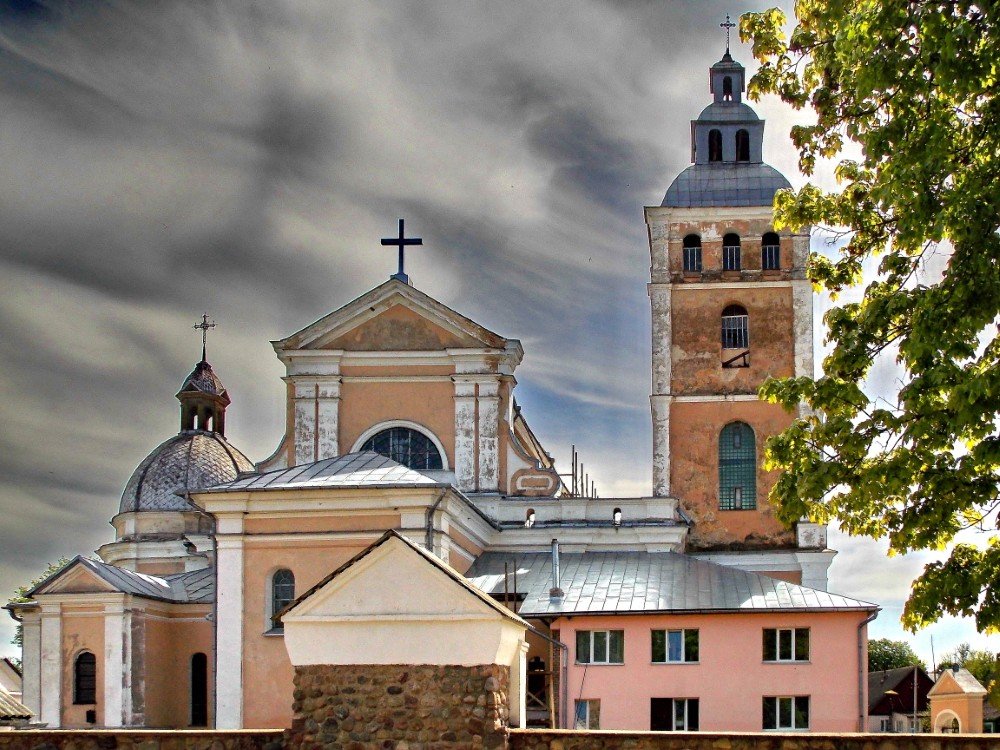
G G10⟫, Svir. The Church of St. Nicholas. The year is 1649.
And the windbreaker I bought was made before 1936. Before the war, he had already worked, and during the war, too, of course, for the Germans, who even put guards on him, since it was then a strategic facility, bread. The landlady from whom I bought this mill said that her father-in-law built it. Of course, when I moved it to the museum and disassembled it, it all fell down. But before that, I carefully measured everything, ran around with a tape measure, and took pictures. And in the end, he restored everything, even the types of wood from which certain parts were made. And there are many varieties there: a turntable from below-oak, friction and resistance elements — oddly enough, birch (since it is considered an old breed), and pine, spruce, aspen…
Flour of various grades can be made in this mill. Large, coarse-grained-for livestock, small-for bread. The deeper I studied the mechanisms of this windmill, the more I was surprised: but our dark ancestors did it. "Dark", of course, in quotation marks.
Besides traveling, shooting, and painting, I also collect legends. Legends from the mouths of people I meet and talk to. These are legends, let's say, of the local variety, those that were born in a particular village or on a particular farm. And I have more than 100 such legends today.
The most decrepit ruin can live for another 100 years if it is not touched and if it is not pushed into a quarry. But the man, he will leave, literally tomorrow he will leave, and what he told us will remain a lost priceless value.
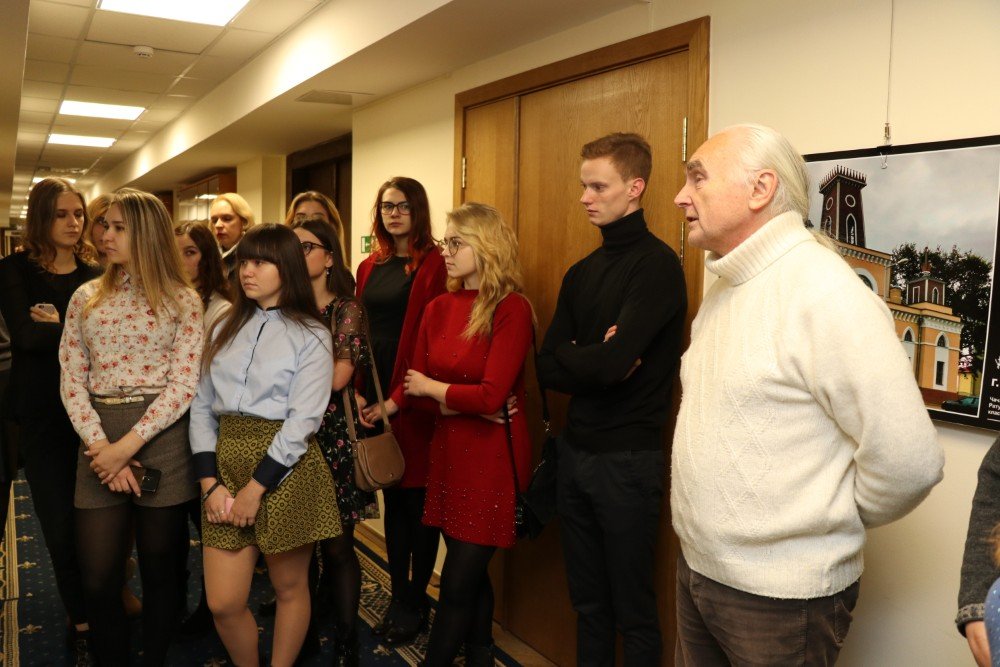
During the guided tour of the exhibition “silhouettes of heritage".
For example, one such legend is about an oak barrel from Canada. The 20-30s were one of the distinctive periods in the lives of residents of Western Belarus, when they actively traveled overseas to earn money. Both alone and in whole art groups-in different ways. And so a man from one village went there with his construction friends to earn money with a whole team. They returned, naturally, rich. In addition to money, they also carried various goods-cloth, dishes, clothes, shoes. And, of course, when these already rich people returned from there, those who wanted to take away what they had brought appeared on our roads. Bandits, in a word. By the way, this is a very interesting page from the life of Belarusians, but for some reason they don't write about it, they don't make films about it. And so our hero, who left his wife and three children in his homeland, was carrying from there, from Canada, a barrel, maybe from gunpowder, maybe from rum, full of various sweets-sweets, chocolates, lollipops... our hero was chosen to be the eldest in the wagon train. When they were almost home, they decided to stop at a place at the fair. And just then, our hero's wife and her father came to the fair to sell something. They met our hero there. His father-in-law told him:”Let's go home together." But he couldn't go right away, because he was the eldest in the wagon train and had to take people to the villages. He only said before saying goodbye:”I'll take everyone home first, and I'll come home in the evening." And, hugging his wife, he took a barrel from his cart, handed it to her, “you can open this barrel at home and treat the children. Let them meet me at home with sweets already"” And off they went. Our hero never returned home that evening. But in the morning, a gendarme appeared and said that when the man had taken half of his friends and the wagon train had become very small, bandits attacked them, killed them all and took all the goods, there was nothing left on the road, only dead bodies. The gendarme asked the relatives to come to the place on a cart and take the body of our hero. You see, what a fate... He handed the barrel of sweets to the children, but he did not return. This story was told to me by the man's granddaughter, now, of course, already a great grandmother. She showed me that barrel, too. She's in my museum now. And that incident happened not far from Ishkoldi.
I also have funny stories. One of them is connected with the German accordion “Tosca". When our soldiers returned from defeated Germany after the war, they brought a lot of those Tosaks here. It's such a small accordion, but despite its small size, it was very easy to pick up melodies on it. And people were glad that they brought these "toskas", because there were almost no harmonicas of their own, and life began to revive, and weddings began, and Christina. Of course, the harmonicists were invited to the holidays. But they only played until the third glass. Why only the third one? The local people answered me. Because when people drank their third glass, they remembered everything, and it began: “where did you get this "Longing" from, and are you playing the fascist ”longing“ here? Oh, you damned fascist!"And then trouble often came. This "Longing" was torn from the hands of the harmonica player, trampled underfoot, and then the harmonica player himself was beaten to a bitter apple. After all, we have these” Tosak " is almost gone. For example, I saw only one in Zaslavl. Well, I have one in the museum too. So ugly, cracked... One harmonica player, who was also beaten because of the harmonica, still saved the instrument. When I left the wedding all broken up, I took her, also all broken up, with me. I immediately threw it into the attic, and so it has lain there to this day. When he, a very old grandfather, showed me this "Longing", he was surprised for a very long time. “And this is an exhibit for your museum?"And there, indeed, the hull is broken, and the fur is torn, and the belt is torn off... "It's okay," I told him, "I'll try to restore it."
Nikolai Chemer.
Photo by the author, Vladimir Tsvirko, and from the archive of the Presidential Library of Belarus.