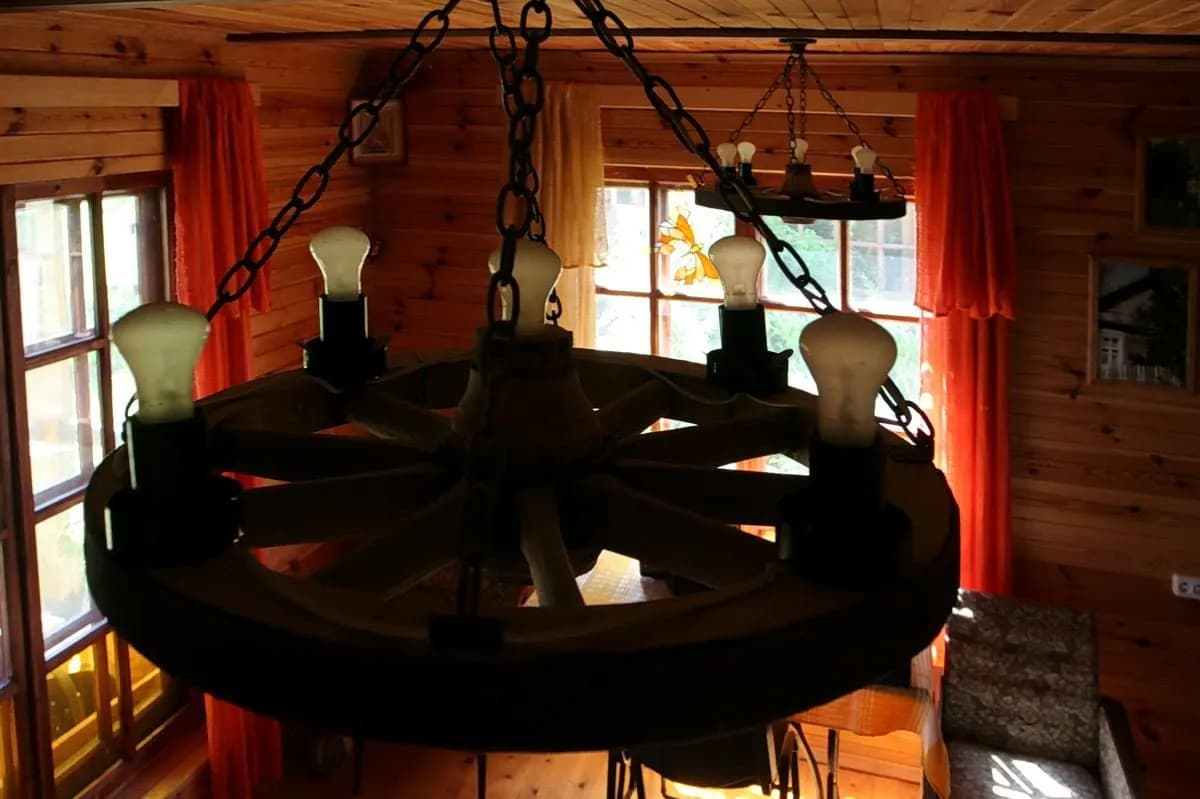
I've been looking for two identical wheelchair wheels for a long time to make a chandelier in the largest room of my house. And then one day, when I was driving through a village, out of the corner of my eye I noticed old wooden stairs in the courtyard. However, the rear axle remained with only one wheel. Apparently, the stirrups had not been used for a long time. As soon as I stopped, the owner of the house came out to meet me, cordially opened the gate and invited me in. We sat down on a narrow bench, dug into the fence under an old jasmine bush. We started talking. I explained why I was interested in ladders, or rather, their wheels, and told them that I wanted to make chandeliers out of them.
"Do you really want to make a chandelier out of them?" - looking into the eyes, my interlocutor asked.
I was even a little confused and assured him that this was indeed the case.
"It's just that many people sell when they get something," said the owner of the house. He thought for a moment, then stood up silently and, waving his hand, invited me to follow him into the house.
They entered a spacious vestibule with a small window. The owner went up a ladder to the attic and provided me with a pair of small wooden circles made very artistically. We returned to the street and sat down on the bench again.
"The wheels from those pellets," he said, continuing the interrupted conversation, "are worn out and rotten in a couple of places. And these... I think you'll be interested to know where I got them from. Tell…
And so. They were made by my grandfather Nikifor. He was known as Stelmakh, a master wheelmaker. It's a very difficult craft, I must say. The owner of a farmyard near the village ordered wheels for his boots. I paid the deposit. It was just before the terrible thirty-seventh. The owner of the farm was taken away by Bolshevik henchmen on a black funnel. But he was an educated and diligent man. The villagers could earn so much from him during the season that they stayed in the heat all winter in prosperity and with food for the whole family.
Years passed, but the owner of the folvarka did not return. And my grandfather put aside the trestle boots and these two ready-made wheels and strictly ordered them not to touch or use them. And suddenly the customer returns, the money is paid in advance. So they stayed in the cage until the forties.
And just before the war, my grandfather died. But even as he was dying, old Nikifor once again commanded his eldest son, my father, to take care of the wheels. He explained again that if the man returned, he would not be ashamed of his old man, since he had earned the deposit.
My father continued my grandfather's business. The whole village, and not even one, is still riding on its wheels today. But he never touched these grandfather's wheels. I fulfilled the order. So they were hidden in the attic all the time. Do you understand how responsible people were? The honest ones, the decent ones. They preserved traditions and business honor ... Not like now..." and, after a short silence, my interlocutor quietly added: "If I don't, someone will steal them away and exchange them for money."…
- And girandoli is a good thing. It's not a pity to give them for this. Will there be lights in the house, then? And for travelers like the lighthouse. But for me, an old man, there is hope... You write about it... suddenly, the relatives of the owner of the folwark will find out and will come and look at the work of the hands of a talented old master…
What can you say after such words? I listened to this man, feeling that now I am even more proud of our ancestors and respect them. Talented and hardworking people who knew what dignity and honor meant.